5 Common Shipping Mistakes to Avoid

5 Common Shipping Mistakes to Avoid


Mastering the nuts and bolts of shipping is a crucial skill for businesses that specialize in transporting their products from one place to another. While shipping is simply defined as placing goods or people on a carrier to be brought to its intended destination, it could be a pretty lengthy and complicated process for those with limited knowledge about logistics, as well as customs requirements.

Shipping also plays a vital role in the capability of an enterprise to provide the highest degree of customer experience to their clients. One way to do this is of course, avoiding mistakes in every shipping transaction as much as possible. Though such a task is easier said than done, the first step a business owner must do is identify the potential shipping errors ahead of time.

Fortunately, we’ve compiled some of the most common shipping mistakes as well as efficient methods of avoiding them:


Improper Packaging

An easy way to increase the chance of shipment damage is by incorrect packaging. Products may vary in shapes and sizes, and some might be even so fragile that a well-secured packaging is required in order for it to be safely moved from point A to point B.

When shipping a set of products, have a thorough assessment of the most appropriate type of box, and invest in high-quality protective cushioning if needed. Having a professional in the shipping industry is another surefire way of preventing damages in shipment brought by improper packaging.


Wrong Shipping Address

Once shippers failed to pay more attention to what is written on the Bill of Lading (BoL) miscommunications with the carrier company might arise. For example, a wrong shipping address could result in freight transporting the products in the wrong destination.

Checking the shipping address multiple times is one and the only solution to prevent this mistake. Make sure that every detail is correct, including the ZIP codes of the intended place.


Letting a Single Carrier handle all Shipments

Availing the service of a single carrier can help foster positive relationships between business the carrier company. However, relying on a single carrier could prove to be a risky option. In the event that a well-trusted carrier company experienced a strike or downscaling of its facilities, its clients could end up having large piles of shipment with no one to move it around.

Creating more connections with multiple carrier companies is one way of avoiding such hassle, not to mention access to opportunities in terms of having competitive rates and operations.


Inaccurate Shipment Weight

Carrier companies tend to be prudent and specific when it comes to weighing the shipments of their clients. They always have certified scales placed at their terminals to make sure that every shipment’s weight is worth the fee they require. Some businesses neglect to weigh their products and as a result, they are forced to pay an additional fee on their bills.

Purchasing a high-quality weighing scale and using it on products beforehand prevents any unnecessary expenditures in shipping.


Not Keeping Delivery Receipts

Delivery receipts serve as evidence that a shipment is free from any damage before the delivering process. Presenting these receipts on situations such as shipment damage provides validity that can save a business from bearing all the costs brought by the damages during the shipment process.


Excelsior Worldwide Freight Logistics conducts free orientation for those who are willing to learn. It is our advocacy to share our knowledge & experience worth more than a decade in the business. Visit our website today at www.excelsior.ph to learn more about our service.

Sources:
5 Questions a Logistics Expert Might Ask You – Infographic

Given the scenario that you’re a business owner looking to ship your goods from coast to coast, you will definitely need someone that can guide you through the process. Requirements that are needed to transfer your shipment could further encumber your already busy schedule. What’s even worse is that unchecked cargo could lead to delayed arrivals and other similar problems which could bring detrimental effects to your supply chain.

Fortunately, you have one option: hire a freight forwarder. In case you don’t know what freight forwarders are, they can be an agent or a company that offers services such as organizing shipments in place of their clients. They always make sure that the client will get the proper assistance they need with all of the customs requirements, other legal processes, etc. They also ensure the safe and timely arrival of goods to its intended destination.

Since they’re dealing with a network of carriers and customs authorities, you should’ve realized by now that freight forwarders are experts in the field of logistics. If you wanted to contact one of them, you must be ready to ask these five questions first so that they can provide you the highest and appropriate kind of service you deserved.

5 Questions a Logistics Expert Might Ask You - Infographic

Question no. 1: What type of commodity you’re planning to ship?

Your chosen freight forwarder will most likely ask what type of commodity you’re planning to ship. Is it something perishable, like fresh meat, fruits, seafood? Or non-perishables such as canned goods, machinery, tools, etc.? Moreover, they will also become curious as to whether your goods are hazardous or requires careful handling and temperature controls.

Question no. 2: What type of carrier would you prefer?

Shipping your goods in air is very different from shipping it in the ocean. The condition of your products (especially the perishable ones) are required depending on the environment of your selected carrier.

Question no. 3: How many cartons do you plan to ship?

Knowing the exact quantity of your shipment is another responsibility of freight forwarders so that they can be certain that all of it will leave point A and will successfully reach point B. You need to be particular in number especially if you have a lot of cartons with different sizes.

Question no. 4: Where are you going to your goods?

Normally, the location would be the manufacturer’s factory. In case you’re going to ship your goods abroad, knowing the location of your shipment’s destination will help a lot in complying with specific documents that may vary from country to country.

Question no. 5: Would you like to stack your cartons on a pallet?

Knowing whether you will stack your cartons on a pallet will enable your freight forwarder to estimate the weight and cubic space that it will occupy. This can help a lot when calculating the total weight and volume of the shipment appropriately.

Excelsior Worldwide Freight Logistics conduct free orientation for those who are willing to learn. It is our advocacy to share our knowledge & experience worth more than a decade in the business. Visit our website today at www.excelsior.ph to learn more about our service.

Pros and Cons of Less Container Load (LCL)

pros and cons of less container load

Less Container Load, or more commonly known as LCL refers to a type of shipment wherein the shipper negotiates with a consolidator to book his cargo even if it doesn’t contain enough goods to accommodate a fully loaded container. The consolidator will then arrange a full container load (FCL) that comes from different shippers. Freight forwarders usually offer this kind of service by helping their clients book a full container and ensure that these goods will successfully arrive at the destination.

If you’re a business owner trying to ship your goods to reach a higher number of customers, you might want to try LCL. But first, you must be aware of several pros and cons of this specific method of transportation:

Pros of Less Container Load:

  1. Affordability – Perhaps the thing that makes LCL a viable choice amongst shippers nowadays is because of its affordability. You don’t have to pay for transporting a full container load as you are only charged according to the volume or the specific area occupied by your cargo inside a carrier.
  2. More Freedom – Availing an LCL manner of transport gives you access to an array of flexible choices especially on the way of how you wanted to receive your shipment. You are pretty much free to decide whether you wanted to go and pick the cargo yourself from the warehouse or not. There’s no need to wait for any middleman to accomplish such job.
  3. You can Still Enjoy the Benefits of FCL – Since the consolidator you hired arranged your cargo into an FCL, you will certainly enjoy the same benefits. In other words, you will only pay for a specific space while your cargo is being transported to the very same facilities.
  4. LCL can Reduce your Expenses in Inventory Management – Since it’s quite convenient to ship smaller orders through LCL, this transporting option also minimizes inventory management costs so you can focus your precious resources on more important matters.

Cons of Less Container Load:

  1. Consignment inspection can be troublesome at times – Since your shipment will be transported with other goods from multiple consignees, it could sometimes mean trouble. In case one of the consignee’s shipment turns out to be something illegal, expect delays or even cancellation of the shipping process.
  2. Shipping Delays can occur – While the transit time for LCL is similar to that of an FCL, having shipping delays with LCL is still possible. The reason for this hassle is because it usually takes around 1 to two days for the container to be thoroughly processed and loaded.

Despite the few disadvantages of transporting goods via LCL, it can never overshadow the benefits that make it a more popular option for many shippers of different business industries.

Excelsior Worldwide Freight Logistics conduct free orientation for those who are willing to learn. It is our advocacy to share our knowledge & experience worth more than a decade in the business. Visit our website today at www.excelsior.ph to learn more about our service.


Sources:

5 Ways to Improve Your Logistics Management – Infographic

Logistics refer to the detailed coordination of a complex operation that involves people, facilities and supplies. In the world of business, logistics is the practice of managing a certain flow of things between the point of origin and point of consumption in order to satisfy the needs of customers and operations.

Many enterprises today tend to pay a lot of attention to the way of how they manage logistics because it basically helps them to increase the value of their business. Logistics have the capability to enhance the merchandise and make the products much more accessible. Additionally, the economy of a country depends heavily on the efficiency of logistics to support the stable movement and flow of many economic operations.

Logistics management is one of the most vital components of business operations as its result often brings a significant impact on the internal processes as well as relation with customers.

Strategic planning and knowledge combined are two of the basic qualities every business leader must have in order to perform excellent logistics management.

To help you achieve such a state where logistics is your business’ primary tool against competitors, here are five ways to improve your logistics management.

5 Ways to Improve Your Logistics Management - Infographic

  1. Keep your inventory intact

Some businesses often made the mistake of putting a large quantity of their stocks in a small warehouse. If your stocks are too many for your warehouse to host, then it might be better to consider partnering with third-party warehousing. Failure to use a suitable facility makes you unable to do efficient inventory management, which may eventually lead to supply shortage and delayed orders.

But if third party warehousing is not a choice for you, it is always better to maintain a sizable inventory at your warehouse as much as possible.

  1. Facilitate dialogue between employees

Character also plays a major role in the success of a business in the aspect of logistics. Establishing deeper relationships among employees promotes a type of mindset that in unity, there is a victory. If you start to facilitate dialogue or healthy conversations with your employees, they will soon be encouraged to do it with each other as well. This can allow them to strengthen their ability to work as a single unit and accomplish their task efficiently and competitively.

  1. Always update your customers

Outstanding logistics management is a way to excel in providing customer service. Once your employees were able to meet the needs and expectations of your customers, it is more likely that your customers will buy more of your products.

If you wanted to amp up your logistics management in relation to customer service, being more transparent on your logistical purchasing processes keeps them more contented and loyal in the long run. This can be done by sending informative emails, tracking numbers, and other information that keeps them well informed.

  1. Provide your employees with adequate training

Members of your staff who regularly manage orders and handle information in a conventional way must be given sufficient training on the more sophisticated and modern methods or techniques. You can discuss this idea with your HR department or ask the software vendor to organize training sessions for your team.

  1. Observe your leading competitors

Though there’s going to be a lot of competition going their way, seeing them as hindrances won’t help you achieve your goal. Instead, you can take a closer look at some of your leading competitors and see what specific abilities and tools they have in order to keep their level of logistical competitiveness high. As a rule of thumb, you can take a note at your competitors:

  • Modern Software Systems
  • Newest techniques and strategies in logistics management
  • Training programs for their staff members

If you wanted to take your logistics management to the next level, take heed of these five tips to ensure that you will maintain competitiveness by organizing your most daunting business processes!

Excelsior Worldwide Freight Logistics conduct free orientation for those who are willing to learn. It is our advocacy to share our knowledge & experience worth more than a decade in the business. Visit our website today at www.excelsior.ph to learn more about our service.

The Six Most Critical Issues In The Philippine Trucking Industry

5 Problems that the Philippine Trucking Industry is Facing Today

For the past decades, the Philippines has been undergoing some constant changes specifically in the trucking industry. Many trucking companies responded by allowing themselves to adjust in order to maintain their foothold in the growing competition.

Despite the recent improvements in the Philippine economy nowadays, the trucking industry seems to be on a race of its own, exerting a sense of pressure and urgency for everyone involved especially the drivers. This event leads to the emergence of new problems and issues that continue to bring detrimental effects on the nation’s trucking industry.

Below are six most critical issues that the Philippine trucking industry is dealing with today:

  1. Excise tax on Fuel

Together with the implementation of TRAIN Law in 2018, the Philippine government also added excise tax on fuel. Diesel users such as trucks will receive a 3-tranche increase which will occur in the following order: Php 2.50 per liter in 2018, Php 4.50 per liter in 2019, and Php 6.00 per liter in 2020. Taxes on fuel has the same effects as the oil price hike as it adds further encumbrance on the part of the truckers.

  1. Age Restriction on Trucks

In the latter days of November 2018, the Department of Transportation (DOTr) suspended the implementation that restricts the age limits of trucks to 15 years. Any trucks that are more than that age threshold will be phased out. Though this move by the government is highly beneficial for the industry, future truck phase-outs in other areas of the country are still in danger of this regulation.

  1. Traffic Congestion

While some people might say that heavy traffic means that the economy is currently adjusting as it grows, we can also see it as a double-edged sword. Traffic congestion has a large number of negative effects on the environment, health, and economy of a country in a variety of ways. It could hinder the productivity of truckers as they are forced to waste a significant amount of time. What’s even worse is that it could persuade the government to impose traffic policies such as a city-wide truck ban.

  1. Oil Price Hike

Oil price hike takes place when the cost of oil starts to increase by a certain percentage. There are a lot of factors that influence the oil prices in the Philippines, such as the currency exchange rate, the supply and demand, and the price of oil in the world market. Unfortunately, most trucking companies prefer not passing the cost to their clients, sustaining a great deal of financial loss in the process.

  1. Truck Ban

Several places in the Philippines particularly Metro Manila has already experienced truck bans because of severe traffic congestion. Because of the size of the trucks, the traffic management agencies often put their blame to such vehicles as the real culprit of congestion. Even some motorists have claimed that trucks are the actual initiators of the problem as they are normally perceived as slow-moving the usual cause of car accidents. The repercussions of this policy could endanger the whole trucking industry, as the banning of trucks can affect not only the providers of these services but also the overall Philippine economy itself.

  1. Implementation of Maximum Gross Vehicle Weight (MAGVW)

According to the Confederation of Truckers Association of the Philippines, the biggest challenge that they need to overcome this year is the implementation of maximum gross vehicle weight for the trucks. Though this regulation’s main purpose is to avoid overloading by limiting the weight of the trucks, the maximum weight allowed for truck codes 12-2 and 12-3 (41,500 and 42,000 kg respectively) could be a major problem indeed. This is because the average weight of containers that the trucks usually carry is around 30-36,000 kg, and if the average weight of the tractor head and trailer would be added (15,000 kg), the vehicle will reach a total weight of about 45,000 kg which is already a violation to the law.

Sources:

Reasons Why You Should Invest in a Transportation Management System (TMS)

Reasons Why You Should Invest in a Transportation Management System (TMS)

As a business owner, it is your duty to maintain the stability of your supply chain in order to ensure that your company is steadily growing on its way to success. Most distribution companies today implement a so-called Transportation Management System or TMS to accomplish such a goal.

What is a Transportation Management System?

Transportation Management System is defined as a subset of supply chain management that involves efficient planning, execution, and optimization of the physical movement of goods. This logistics platform can basically give you information that allows you to lower your expenses on shipping, saving you a lot of time and money in the long run. But the benefits don’t end there, though.

Here are five other reasons why you should invest in a Transport Management System or TMS:

  • It improves your cash flow

Your cash flow is an important factor that keeps your business up and running. Without it, you will find yourself unable to buy inventory or even pay your employees. In fact, studies have shown that 82% of businesses today fail due to poor cash flow management. Fortunately enough, a transportation management system can help you improve your cash flow. Through centralized billing support and freight bill audit and payment features, you can save more money and keep it flowing in your business without experiencing too much difficulty. You can also standardize your payment terms for your shipments so you can easily budget and manage your cash flow since you have a more accurate picture of all those payables, receivables, and freight invoices.

  • Better warehouse management

Maximizing your warehouse duties is very important. With a transportation management system, you don’t have to spend a lot of time on managing freight tasks as you already have a thorough and optimized plan to do that. This way, you can focus more on other important aspects of the business because you have a greater overall supply chain visibility that helps you to make better decisions when dealing with any financial issues.

  • It improves customer service

Investing in a transportation management system enables you to have access to analytics and reports that show how your decisions affect customer service. These reports can make you aware of what carriers you use to ship your goods, how much their service costs, and if whether they often deliver on time or not. This way, you can improve your customer service by determining the best carrier for your business. TMS can also make you inform your customers about the current state of their order, giving them adequate tracking information and experience.

  • Better inventory management

TMS can also provide you some updates about the condition of orders and shipments in real time. By monitoring each step of the process, you can be aware of how much inventory you left and therefore, identify your future needs.

  • It can reduce invoice errors

Errors in invoices, particularly on freight payment and audit processes, can be quite common on manual procedures. TMS can negate these errors by using computerized or automated procedures.


Sources:

The Impact of Natural Disasters on Freight Shipping

The Impact of Natural Disasters on Freight Shipping

In terms of economy, any country will always rely on the continuous transportation of goods and materials that keeps the relationship between suppliers and manufacturers in harmony. This process is very critical for maintaining economic growth because any moment of disruption could bring serious adverse effects. Some of these disruptions are caused by certain deregulations in the financial industry that are to some extent, quite avoidable. However, another thing that can affect a country’s economy is freight shipping, which can sometimes depend on several factors that unfortunately are beyond our control: natural disasters.

Speaking about natural disasters in the Philippines, the likes of floods, typhoons, and earthquakes, are quite common. These calamities typically leave most of the routes that are essential for freight shipping operations unsafe such as roads and seas. This reason is also why you should also be aware of the following ways of how nature can make a significant impact on freight shipping:

The Price of Fuel

One of the most critical prices to look out for when there’s a natural calamity going on is the price of fuel in the world market. Since the cost of most goods and other services are very much dependent on the value of fuel as the source of transportation, your chosen carrier can charge you more than usual. The worst-case scenario in this situation is when there’s a typhoon going on oil refineries strong enough to make it temporarily shut down due to damages.

The Expected Arrival of your Goods

Time is more than just gold in the world of business. Importing your goods in a faraway place requires a definite amount of time to keep up against competitors that are nearer than your target customer. Moreover, if you sell something that thrives on punctuality to retain its usefulness such as food, you should know by now that delayed delivery can ruin its condition. So, if you just shipped your goods during a storm, you better expect for the worse. Carriers tend to choose longer routes over the shorter ones if they find the latter impassable due to the dangers involved.

Refusal of Carriers to take your Cargo

Natural disasters will always make most carriers to be more vigilant to take anyone’s goods. Denial of your goods directly gives detrimental effects on your supply chain, eventually losing considerable revenues in the long run. Just imagine all of your business operations being halted in such a significant amount of time.

Freight Shipping Rates

Rates for freight shipping is always flexible especially on the event of calamities. A domino-effect will most likely happen until it makes its way for you. From the impassable roads making the fuel much more expensive to the delayed accomplishment of shipping service, most financial burdens will be passed into you.

Conclusion

As a business owner looking to ship your goods, anticipating natural disasters is a key for preventing any financial loses that can delay your company’s growth. Always take heed of the weather updates and recent news before making any move.

Sources:

5 Questions to Ask your Freight Forwarder – Infographic

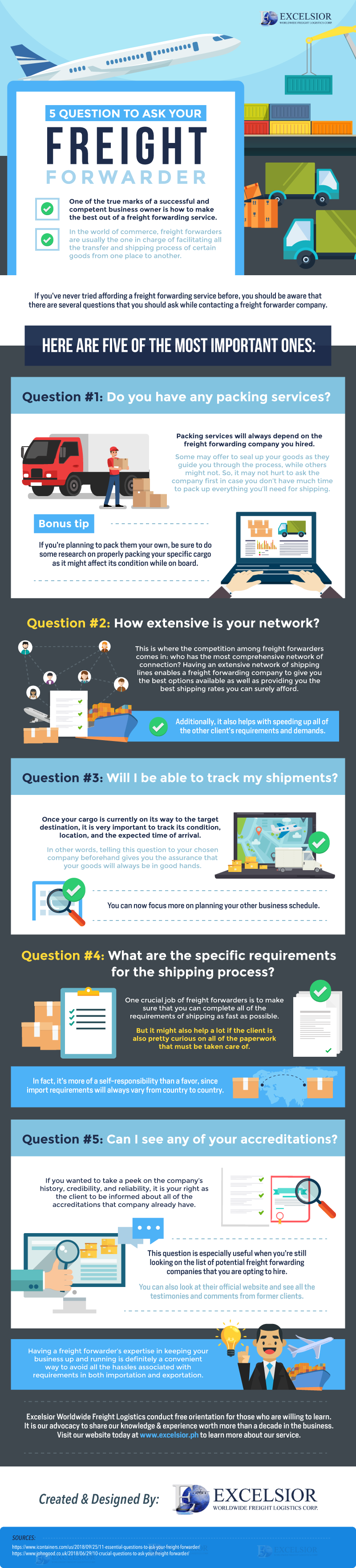
One of the true marks of a successful and competent business owner is how to make the best out of a freight forwarding service. In the world of commerce, freight forwarders are usually the one in charge of facilitating all the transfer and shipping process of certain goods from one place to another.

If you’ve never tried affording a freight forwarding service before, you should be aware that there are several questions that you should ask while contacting a freight forwarder company. Here are five of the most important ones:

5 Questions to Ask your Freight Forwarder - Infographic

Question #1: Do you have any packing services?

Packing services will always depend on the freight forwarding company you hired. Some may offer to seal up your goods as they guide you through the process, while others might not. So, it may not hurt to ask the company first in case you don’t have much time to pack up everything you’ll need for shipping.

Bonus tip: If you’re planning to pack them your own, be sure to do some research on properly packing your specific cargo as it might affect its condition while on board.

Question #2: How extensive is your network?

This is where the competition among freight forwarders comes in: who has the most comprehensive network of connection? Having an extensive network of shipping lines enables a freight forwarding company to give you the best options available as well as providing you the best shipping rates you can surely afford.

Additionally, it also helps with speeding up all of the other client’s requirements and demands.

Question #3: Will I be able to track my shipments?

Once your cargo is currently on its way to the target destination, it is very important to track its condition, location, and the expected time of arrival. In other words, telling this question to your chosen company beforehand gives you the assurance that your goods will always be in good hands.

You can now focus more on planning your other business schedule.

Question #4: What are the specific requirements for the shipping process?

One crucial job of freight forwarders is to make sure that you can complete all of the requirements of shipping as fast as possible. But it might also help a lot if the client is also pretty curious on all of the paperwork that must be taken care of. In fact, it’s more of a self-responsibility than a favor, since import requirements will always vary from country to country.

Question #5: Can I see any of your accreditations?

If you wanted to take a peek on the company’s history, credibility, and reliability, it is your right as the client to be informed about all of the accreditations that company already have. This question is especially useful when you’re still looking on the list of potential freight forwarding companies that you are opting to hire. You can also look at their official website and see all the testimonies and comments from former clients.

Having a freight forwarder’s expertise in keeping your business up and running is definitely a convenient way to avoid all the hassles associated with requirements in both importation and exportation.

Excelsior Worldwide Freight Logistics conduct free orientation for those who are willing to learn. It is our advocacy to share our knowledge & experience worth more than a decade in the business. Visit our website today at www.excelsior.ph to learn more about our service.

What’s the Difference Between a Freight Forwarder and a Customs Broker – Infographic

Some exporters nowadays often mistook a freight forwarder for a customs broker and vice versa. While may be working in the same industry, both are fairly different from each other. Here are some of the telltale facts that draw the fine line between the two professions.

Difference Between a Freight Forwarder and a Customs Broker - Infographic

1. Definitions

A Freight Forwarder is an agent or company that specializes in logistics and organizing of shipments in place of an individual or a company, to transport their goods. This kind of service usually requires a great deal of connection in the supply chain.

On the other hand, a Customs Broker is a private individual or firm that serves as guide for both importers and exporters in meeting the necessary requirements given by the customs authorities.

2. Duties and Responsibilities

Freight Forwarders are the ones responsible for handling all the processes when it comes in exportation of a cargo. From bringing the goods to its mode of shipment (e.g. truck, plane, or ship) to its arrival at the target destination, the freight forwarders have it all covered.  They also give advice as to how to get the best deal for the cost of transportation, as well as guarantee the safety and timely arrival of the goods. To know more about the importance of a freight forwarder please check out the infographic

here
.

Customs Brokers are in charge of submitting all important documents like clearances in order for the shipments to be legally allowed to enter its country of destination. They also tend to have a wide area of knowledge when it comes in every entry procedure, including other payments like taxes and fees for imported merchandise. In addition to that they can also help shippers through the following:

  • Customs bonds
  • Importer Security Fillings
  • Dispatching for final delivery
  • Duty drawback
  • Reconciliation

One thing custom broker can be similar with freight forwarders is that they can as well give recommendations. Only this time, they do it for the purpose of providing the client on getting the most efficient way of clearing their goods in accordance to customs entry rules and regulations.

3. Can a Freight Forwarder be a Customs Broker at the same time?

Since Freight forwarders can be a wider term compared to customs brokers which has a more specific job, there are cases in which a freight forwarder can offer services similar to that of a customs broker. However, not every customs broker can be a freight forwarder.

For many business owners trying import or export their goods, having both freight forwarders and customs brokers are very critical in ensuring its proper arrival on time while adhering to the complicated rules and process of international shipment.

Excelsior Worldwide Freight Logistics conduct free orientation for those who are willing to learn more about importation and exportation. It is our advocacy to share our knowledge & experience for 17 years in the business. Visit our website today at www.excelsior.ph to learn more about our service.

5 Questions to Ask Before You Hire a Freight Forwarder (Infographic)

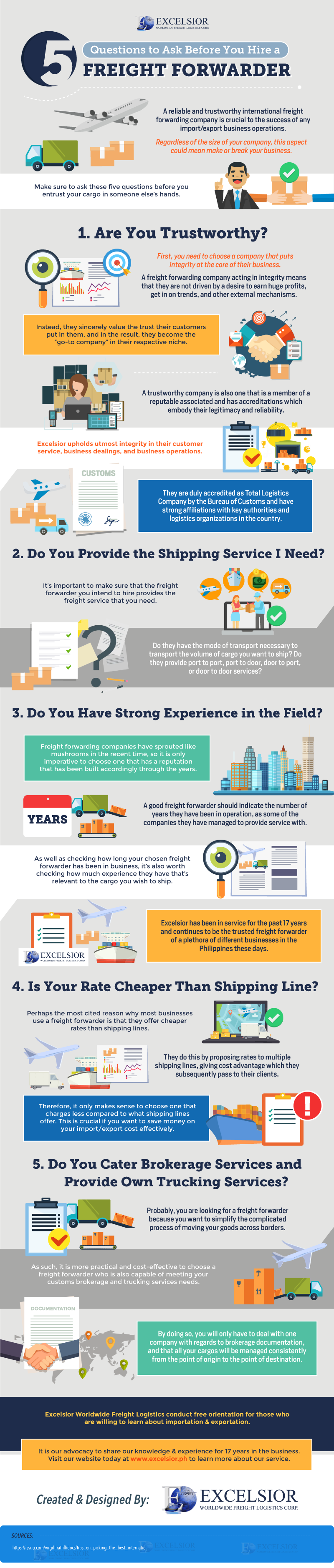
A reliable and trustworthy international freight forwarding company is crucial to the success of any import/export business operations. Regardless of the size of your company, this aspect could mean make or break your business.

Make sure to ask these five questions before you entrust your cargo in someone else’s hands.

1. Are You Trustworthy?

First, you need to choose a company that puts integrity at the core of their business. A freight forwarding company acting in integrity means that they are not driven by a desire to earn huge profits, get in on trends, and other external mechanisms. Instead, they sincerely value the trust their customers put in them, and in the result, they become the “go-to company” in their respective niche.

A trustworthy company is also one that is a member of a reputable associated and has accreditations which embody their legitimacy and reliability.

Excelsior upholds utmost integrity in their customer service, business dealings, and business operations. They are duly accredited as Total Logistics Company by the Bureau of Customs and have strong affiliations with key authorities and logistics organizations in the country.

2. Do You Provide the Shipping Service I Need?

It’s important to make sure that the freight forwarder you intend to hire provides the freight service that you need. Do they have the mode of transport necessary to transport the volume of cargo you want to ship? Do they provide port to port, port to door, door to port, or door to door services?

3. Do You Have Strong Experience in the Field?

Freight forwarding companies have sprouted like mushrooms in the recent time, so it is only imperative to choose one that has a reputation that has been built accordingly through the years. A good freight forwarder should indicate the number of years they have been in operation, as some of the companies they have managed to provide service with.

As well as checking how long your chosen freight forwarder has been in business, it’s also worth checking how much experience they have that’s relevant to the cargo you wish to ship. Excelsior has been in service for the past 17 years and continues to be the trusted freight forwarder of a plethora of different businesses in the Philippines these days.

4. Is Your Rate Cheaper Than Shipping Line?

Perhaps the most cited reason why most businesses use a freight forwarder is that they offer cheaper rates than shipping lines. They do this by proposing rates to multiple shipping lines, giving cost advantage which they subsequently pass to their clients.  Therefore, it only makes sense to choose one that charges less compared to what shipping lines offer. This is crucial if you want to save money on your import/export cost effectively.

5. Do You Cater Brokerage Services and Provide Own Trucking Services?

Probably, you are looking for a freight forwarder because you want to simplify the complicated process of moving your goods across borders. As such, it is more practical and cost-effective to choose a freight forwarder who is also capable of meeting your customs brokerage and trucking services needs.

By doing so, you will only have to deal with one company with regards to brokerage documentation, and that all your cargos will be managed consistently from the point of origin to the point of destination.

Excelsior Worldwide Freight Logistics conduct free orientation for those who are willing to learn about importation & exportation. It is our advocacy to share our knowledge & experience for 17 years in the business. Visit our website today at www.excelsior.ph to learn more about our service. 


Sources:
https://issuu.com/virgill.ratliff/docs/tips_on_picking_the_best_internatio

Excelsior Worldwide Logistics Corp.