6 Tips to Prevent Delays in Shipping During the Christmas Season

The Christmas season is often portrayed as the most wonderful time of the year, but for everyone involved in shipping, it is also the most active and most critical. In 2024 alone, industry analysts had anticipated to account over 60% of total retail sales during the season, a rise from the 55% in 2023. This has proved the boosting customer reliance on online platforms for holiday purchases, putting drastic strain on logistics systems.

With e-commerce booming and more consumers opting for online purchases, the need for reliable and timely delivery amplifies. Businesses rush to meet customer expectations, families send gifts across borders, and supply chains face immense pressure. If you’re not prepared, shipping delays can easily ruin your plans.

In the Philippines, peak shipping demand kicks in by mid-November and lasts until early January. During this time, freight forwarders, courier services, and even custom authorities are pushed to their limits. Yet, understanding how to handle this spike is key to sidestepping missed deadlines and unsatisfied customers.

How to Prevent Shipping Delays During Christmas?

If you’re running an online store or simply shipping gifts abroad, a few smart strategies can help you stay ahead of the holiday chaos. Here are some simple yet practical strategies in shipping during the Christmas season:

1. Plan and Ship Ahead for the Holiday Season

Timing your shipments accurately is one of the most usable ways to dodge delays. Sending parcels early gives you a buffer for any issues like customs clearance, traffic, or bad weather. For businesses, conveying realistic cutoff dates with your customers ensures both parties are aligned on expectations.

Further, planning and shipping ahead of the occupied holiday season lets you to avoid spending express services later on, which could be costly during the peak period. Whether you’re employing local or international freight forwarding, early planning is your best defense against disruption, helping logistics partners design and process shipments more efficiently.

2. Work with a Dependable Logistics Provider

A professional freight forwarder can make the shipping process far streamlined during active seasons like Christmas. They manage everything from documentation and customs clearance to carrier coordination. When volume increases in December, partnering with a steadfast provider who’s familiar with the ins and outs of local and international logistics become essential.

Also, they help reduce the likelihood of errors that may cause delays, such as mistaken paperwork, poorly designed routes and schedules, or supply chain issues. They can consolidate your goods and optimize delivery timelines, allowing you save both time and money.

3. Utilize Real-Time Tracking

Real-time tracking is a necessity during the holiday rush. Many modern logistics company in the Philippines offer shipment tracking platforms that allow you to monitor your parcel every step of the way. This visibility gives you the power to act quickly if delays occur.

If you detect a shipment is held at customs or delayed at a port, you can notify your consumers in advance and manage their expectations. Tracking tools also help you better coordinate with your logistics partners, making the procedure smoother and more transparent on all ends.

4. Ensure Proper Packaging and Labeling

Proper packaging is vital, especially when sending fragile items or sending goods internationally. Carriers are more likely to postpone or reject parcels that are improperly sealed. Therefore, use strong, standard-sized boxes, secure your items well, and avoid excessive bulk that could increase shipping fees.

More so, put clear and correct labels to lower the risk of misrouted shipments, something that becomes more expected when sorting centers are overwhelmed. For global freight forwarding, make sure your labels meet destination country requirements to deter custom hold-ups.

5. Prepare Complete Shipping Documents

Incomplete and inaccurate documents are one of the leading causes of shipping delays, especially for international shipping. Double-check all paperwork, including commercial invoices, packing lists, and customs declarations.

Also, if you’re unfamiliar with documentation needs, working with a customs broker can make a huge difference. They’ll help you prevent typical mistakes and guarantee smooth operations through customs, which is important when holiday freight is under stricter inspections.

6. Communicate Proactively with Customers or Partners

Transparent communication makes trust, especially during high-pressure seasons. If you’re a retailer, inform your customers about holiday shipping deadlines, possible delays, and order tracking options. This helps establish realistic expectations and eases customer service issues.

You may keep your partners updated on shipment statuses and any potential disruptions. Timely updates allow others in your supply chain to modify their operations accordingly. Proactive communication assures that delays, if they occur, don’t lead to more significant problems.

Conclusion

Christmas season doesn’t have to mean missed deadlines or frustrated consumers. With the right planning and a reliable logistics team, you can function in holiday rush with confidence. You can certainly deter costly delays, guarantee smoother deliveries, and give your customers the service they deserve.

Excelsior Philippines is a trusted name in the logistics industry, offering end-to-end solutions in freight forwarding, breakbulk shipping, customs brokerage services, and international shipping. As a leading logistics company in the Philippines, Excelsior helps businesses of all sizes in streamlining shipping operations, navigating requirements, and efficient deliveries on time.

Read more:

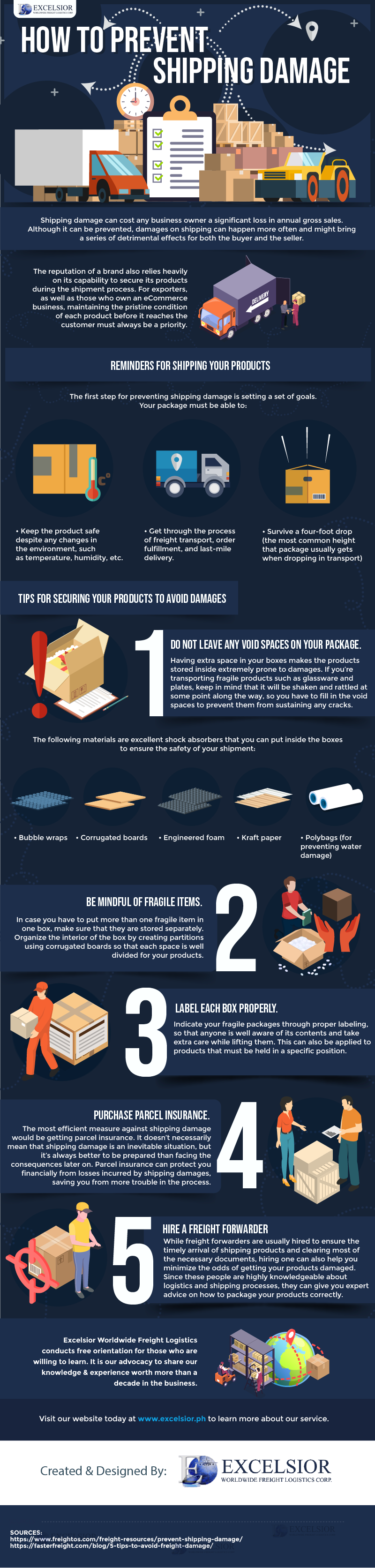
How to Prevent Shipping Damage – Infographic

Shipping damage can cost any business owner a significant loss in annual gross sales. Although it can be prevented, damages on shipping can happen more often and might bring a series of detrimental effects for both the buyer and the seller.

The reputation of a brand also relies heavily on its capability to secure its products during the shipment process. For exporters, as well as those who own an eCommerce business, maintaining the pristine condition of each product before it reaches the customer must always be a priority.

How to Prevent Shipping Damage - Infographic

Reminders for Shipping Your Products

To first step for preventing shipping damage is setting a set of goals. Your package must be able to:

  • Keep the product safe despite any changes in the environment, such as temperature, humidity, etc.
  • Get through the process of freight transport, order fulfillment, and last-mile delivery.
  • Survive a four-foot drop (the most common height that package usually gets when dropping in transport)

Tips for Securing Your Products to Avoid Damages

  1. Do not leave any void spaces on your package.

Having extra space in your boxes makes the products stored inside extremely prone to damages. If you’re transporting fragile products such as glassware and plates, keep in mind that it will be shaken and rattled at some point along the way, so you have to fill in the void spaces to prevent them from sustaining any cracks.

The following materials are excellent shock absorbers that you can put inside the boxes to ensure the safety of your shipment:

  • Bubble wraps
  • Corrugated boards
  • Engineered foam
  • Kraft paper
  • Polybags (for preventing water damage)
  1. Be mindful of fragile items.

In case you have to put more than one fragile item in one box, make sure that they are stored separately. Organize the interior of the box by creating partitions using corrugated boards so that each space is well divided for your products.

  1. Label each box properly.

Indicate your fragile packages through proper labeling, so that anyone is well aware of its contents and take extra care while lifting them. This can also be applied to products that must be held in a specific position.

  1. Purchase parcel insurance.

The most efficient measure against shipping damage would be getting parcel insurance. It doesn’t necessarily mean that shipping damage is an inevitable situation, but it’s always better to be prepared than facing the consequences later on. Parcel insurance can protect you financially from losses incurred by shipping damages, saving you from more trouble in the process.

  1. Hire a freight forwarder

While freight forwarders are usually hired to ensure the timely arrival of shipping products and clearing most of the necessary documents, hiring one can also help you minimize the odds of getting your products damaged. Since these people are highly knowledgeable about logistics and shipping processes, they can give you expert advice on how to package your products correctly.

Excelsior Worldwide Freight Logistics conducts free orientation for those who are willing to learn. It is our advocacy to share our knowledge & experience worth more than a decade in the business. Visit our website today at www.excelsior.ph to learn more about our service.

5 Most Common Shipping Problems

5 Most Common Shipping Problems

The shipping industry in countries like the Philippines is often involved with a lot of requirements when it comes to transporting goods from one place to another. Due to the complexity of the shipping process, it’s not surprising to know that issues and other problems might arise which could disrupt the supply chain of those businesses who rely on services like freight shipping.

Fortunately, such issues can be apprehended by hiring a trusted freight forwarder and customs broker. But still, it would be an advantage for those who are investing a lot in import and export business to be aware of the most shipping problems.

Problem #1 – Missing Documents

The most important document that must always be present at hand during the shipping process is no other than that original copy of the Bill of Lading (BOL). It might sound like a no-brainer but believe it or not, many shippers tend to misplace them due to certain reasons. If you ended up losing your Bill of Lading, there’s a high chance that you will experience delays with the release of your shipment. Make sure that your Bill of Lading is always secured via a reliable channel.

Problem #2 – Unanticipated Closures and Cancelations

One troublesome shipping problem that frustrates many businesses nowadays is when unexpected events happen, leading to the port getting closed or the freight carrier canceling its trip to the destination. The reasons may include strikes by port workers or truckers, and natural disasters. In cases of natural disasters, it’s always better to face the delays instead of the carrier risking the safety of everyone on board and your shipment.

Problem #3 – Overweight Cargo

Failure to properly check the weight of the cargo often results in several problems throughout the shipping process. First, there’s going to be inaccuracies to the documents as the cargo’s weight is essential information that must be submitted. Second, the shipment might become so heavy that it will require different lifting equipment, wasting you a lot of time and (and most likely, money) in the long run.

Problem #4 – Lost Shipment

In addition to missing documents, every shipper must know that if they’re going to have their goods transported on a massive carrier, chances of it going missing are quite high. Ports are now starting to grow larger, and with a plethora of other shipments, you will have to hire a trusted third-party agent to keep an eye on your products.

Problem #5 – Holidays

National holidays can be a good time for being merry and taking some rest from work, but it could mean delays on your part as the shipper. To prevent such problem, do some research on the upcoming port or terminal closures at both origin and destination. Anticipate the holidays by scheduling your shipment before the specific dates, unless you have to suffer a stressful shipping process filled with tons of other cargoes and port congestion.

Excelsior Worldwide Freight Logistics conducts free orientation for those who are willing to learn. It is our advocacy to share our knowledge & experience worth more than a decade in the business. Visit our website today at www.excelsior.ph to learn more about our service.

5 Common Shipping Mistakes to Avoid

5 Common Shipping Mistakes to Avoid

Mastering the nuts and bolts of shipping is a crucial skill for businesses that specialize in transporting their products from one place to another. While shipping is simply defined as placing goods or people on a carrier to be brought to its intended destination, it could be a pretty lengthy and complicated process for those with limited knowledge about logistics, as well as customs requirements.

Shipping also plays a vital role in the capability of an enterprise to provide the highest degree of customer experience to their clients. One way to do this is of course, avoiding mistakes in every shipping transaction as much as possible. Though such a task is easier said than done, the first step a business owner must do is identify the potential shipping errors ahead of time.

Fortunately, we’ve compiled some of the most common shipping mistakes as well as efficient methods of avoiding them:


Improper Packaging

An easy way to increase the chance of shipment damage is by incorrect packaging. Products may vary in shapes and sizes, and some might be even so fragile that a well-secured packaging is required in order for it to be safely moved from point A to point B.

When shipping a set of products, have a thorough assessment of the most appropriate type of box, and invest in high-quality protective cushioning if needed. Having a professional in the shipping industry is another surefire way of preventing damages in shipment brought by improper packaging.


Wrong Shipping Address

Once shippers failed to pay more attention to what is written on the Bill of Lading (BoL) miscommunications with the carrier company might arise. For example, a wrong shipping address could result in freight transporting the products in the wrong destination.

Checking the shipping address multiple times is one and the only solution to prevent this mistake. Make sure that every detail is correct, including the ZIP codes of the intended place.


Letting a Single Carrier handle all Shipments

Availing the service of a single carrier can help foster positive relationships between business the carrier company. However, relying on a single carrier could prove to be a risky option. In the event that a well-trusted carrier company experienced a strike or downscaling of its facilities, its clients could end up having large piles of shipment with no one to move it around.

Creating more connections with multiple carrier companies is one way of avoiding such hassle, not to mention access to opportunities in terms of having competitive rates and operations.


Inaccurate Shipment Weight

Carrier companies tend to be prudent and specific when it comes to weighing the shipments of their clients. They always have certified scales placed at their terminals to make sure that every shipment’s weight is worth the fee they require. Some businesses neglect to weigh their products and as a result, they are forced to pay an additional fee on their bills.

Purchasing a high-quality weighing scale and using it on products beforehand prevents any unnecessary expenditures in shipping.


Not Keeping Delivery Receipts

Delivery receipts serve as evidence that a shipment is free from any damage before the delivering process. Presenting these receipts on situations such as shipment damage provides validity that can save a business from bearing all the costs brought by the damages during the shipment process.


Excelsior Worldwide Freight Logistics conducts free orientation for those who are willing to learn. It is our advocacy to share our knowledge & experience worth more than a decade in the business. Visit our website today at www.excelsior.ph to learn more about our service.

Sources:

Excelsior Worldwide Logistics Corp.