Tips for Saving Money on Freight Shipping – Infographic

For any business owner trying to sell their products overseas, saving money on shipping costs can be a breather. While it may seem like going for cheaper shipping services isn’t a good idea, there are several methods that can help any company in reducing their shipping expenses while increasing margins and enhancing customer satisfaction at the same time.

In case your shipping costs is giving a negative toll to your profit, here are some of the best ways of saving money on freight shipping:

Tip #1: Select the Most Suitable Mode of Transportation

To be an efficient importer/exporter, it is your duty to understand and assess which of the most common mode of transportations is the best one for you.

Here is a list of transportation models that are highly available today:

  • Air Shipment
  • Rail Shipment
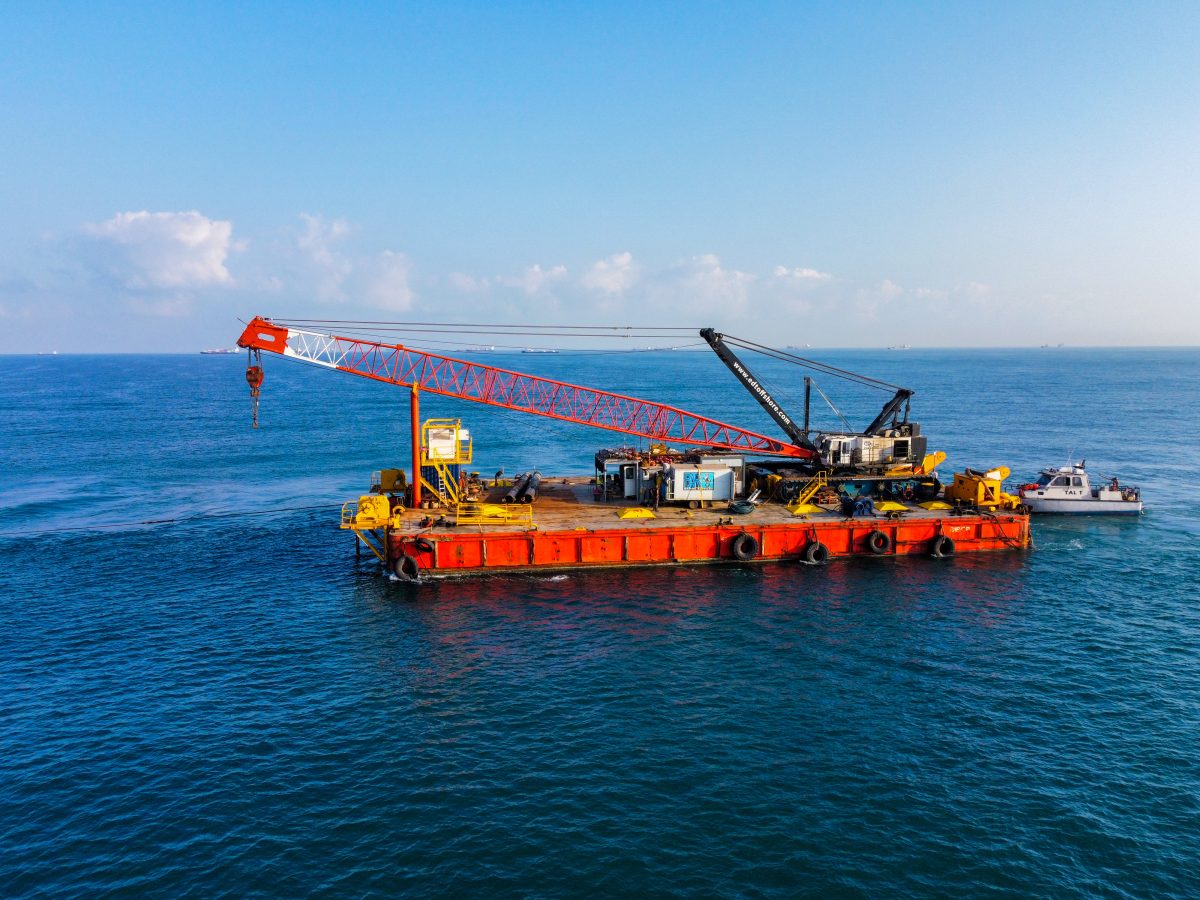
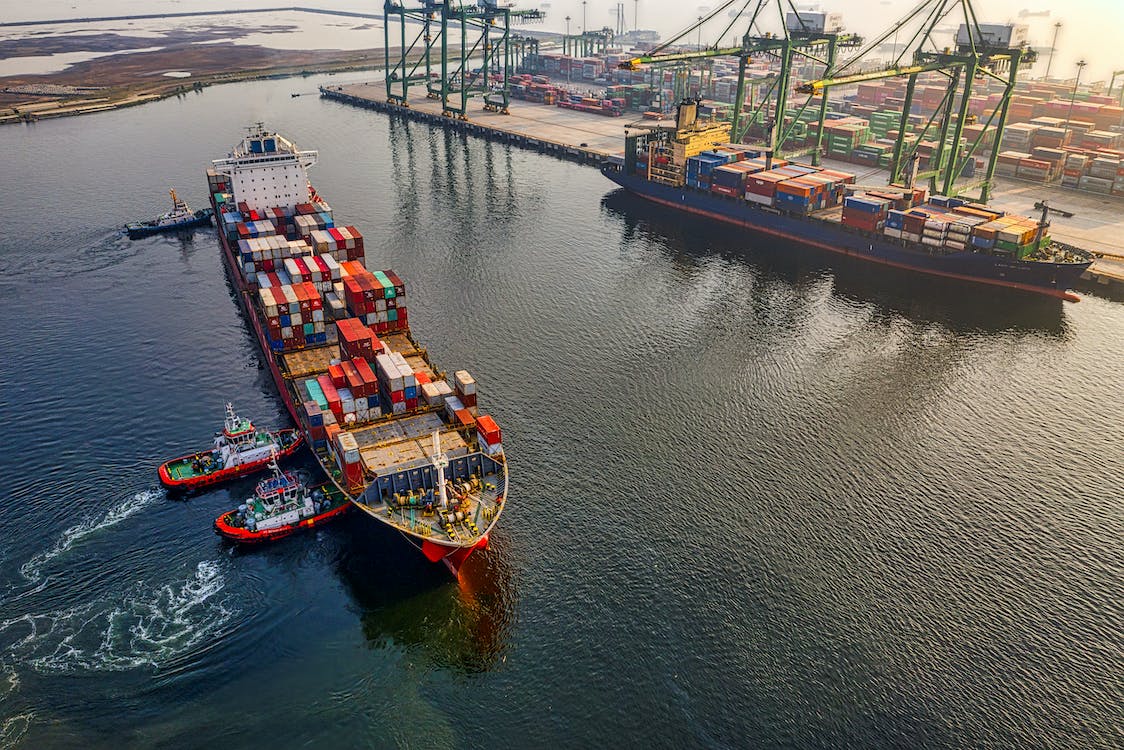
  • Ocean Vessel
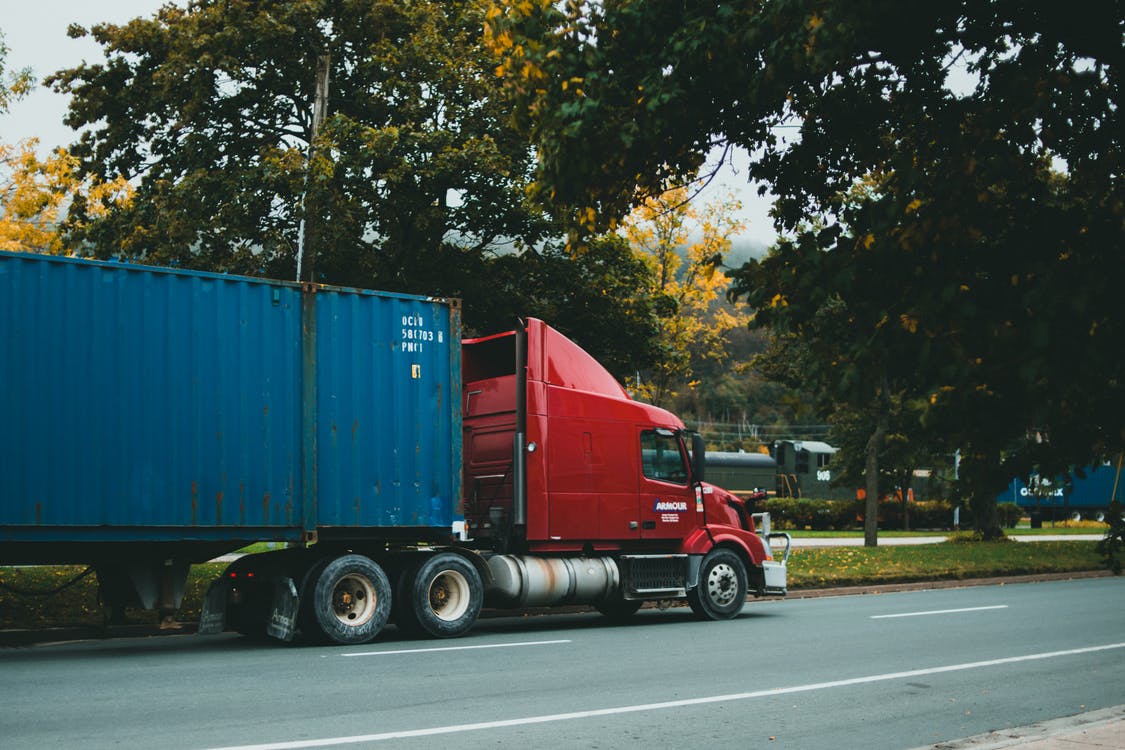
  • Over-the-Road Trucking

Knowing how to weigh your options in terms of choosing the mode of transportation can make it easier for you to select a specific carrier company to entrust your products.

Tip #2: Research a List of Carrier Companies and Compare their Rates

Expanding your choices of carrier companies enables you to periodically check whether you’re already using the least costly carrier service available or not. Try asking each carrier for a freight quote and invest in a reliable TMS software to automate this method.

Tip #3: Be Practical with Your Packaging Materials

If you’re running a retail store, reusing the packaging materials you received (like packing peanuts, air pillows, bubble wrap, etc.) from your suppliers is much more economical. You should also pay attention to the weight of your shipment. Make sure that you will prefer lighter packaging materials over the heavier ones. For example, it’s better to use packing peanuts instead of wool blankets.

Tip #4: Consolidate Your Shipment

Avoid sending over multiple boxes to the carrier if it’s possible to pack them together to form a single cargo. Consolidating your shipment can restrict its weight, density, and the odds of taking damage or loss.

Tip #5: Hire a Freight Forwarder

One of the most effective ways of minimizing your shipping expenses is by seeking the help of a freight forwarding agency. Having a reliable freight forwarder can be an advantage as they are well-connected with multiple carrier companies which enables them to negotiate the best rate for transporting your products. Moreover, freight forwarders can also provide you with knowledge about logistics in ways that could benefit your business.

Apply these five tips in your shipping operations to ensure that you will be able to conserve your resources and ultimately increase your profit!

Excelsior Worldwide Freight Logistics conducts free orientation for those who are willing to learn. It is our advocacy to share our knowledge & experience worth more than a decade in the business. Visit our website today at www.excelsior.ph to learn more about our service.

5 Questions a Logistics Expert Might Ask You – Infographic

Given the scenario that you’re a business owner looking to ship your goods from coast to coast, you will definitely need someone that can guide you through the process. Requirements that are needed to transfer your shipment could further encumber your already busy schedule. What’s even worse is that unchecked cargo could lead to delayed arrivals and other similar problems which could bring detrimental effects to your supply chain.

Fortunately, you have one option: hire a freight forwarder. In case you don’t know what freight forwarders are, they can be an agent or a company that offers services such as organizing shipments in place of their clients. They always make sure that the client will get the proper assistance they need with all of the customs requirements, other legal processes, etc. They also ensure the safe and timely arrival of goods to its intended destination.

Since they’re dealing with a network of carriers and customs authorities, you should’ve realized by now that freight forwarders are experts in the field of logistics. If you wanted to contact one of them, you must be ready to ask these five questions first so that they can provide you the highest and appropriate kind of service you deserved.

5 Questions a Logistics Expert Might Ask You - Infographic

Question no. 1: What type of commodity you’re planning to ship?

Your chosen freight forwarder will most likely ask what type of commodity you’re planning to ship. Is it something perishable, like fresh meat, fruits, seafood? Or non-perishables such as canned goods, machinery, tools, etc.? Moreover, they will also become curious as to whether your goods are hazardous or requires careful handling and temperature controls.

Question no. 2: What type of carrier would you prefer?

Shipping your goods in air is very different from shipping it in the ocean. The condition of your products (especially the perishable ones) are required depending on the environment of your selected carrier.

Question no. 3: How many cartons do you plan to ship?

Knowing the exact quantity of your shipment is another responsibility of freight forwarders so that they can be certain that all of it will leave point A and will successfully reach point B. You need to be particular in number especially if you have a lot of cartons with different sizes.

Question no. 4: Where are you going to your goods?

Normally, the location would be the manufacturer’s factory. In case you’re going to ship your goods abroad, knowing the location of your shipment’s destination will help a lot in complying with specific documents that may vary from country to country.

Question no. 5: Would you like to stack your cartons on a pallet?

Knowing whether you will stack your cartons on a pallet will enable your freight forwarder to estimate the weight and cubic space that it will occupy. This can help a lot when calculating the total weight and volume of the shipment appropriately.

Excelsior Worldwide Freight Logistics conduct free orientation for those who are willing to learn. It is our advocacy to share our knowledge & experience worth more than a decade in the business. Visit our website today at www.excelsior.ph to learn more about our service.
5 Ways to Improve Your Logistics Management – Infographic

Logistics refer to the detailed coordination of a complex operation that involves people, facilities and supplies. In the world of business, logistics is the practice of managing a certain flow of things between the point of origin and point of consumption in order to satisfy the needs of customers and operations.

Many enterprises today tend to pay a lot of attention to the way of how they manage logistics because it basically helps them to increase the value of their business. Logistics have the capability to enhance the merchandise and make the products much more accessible. Additionally, the economy of a country depends heavily on the efficiency of logistics to support the stable movement and flow of many economic operations.

Logistics management is one of the most vital components of business operations as its result often brings a significant impact on the internal processes as well as relation with customers.

Strategic planning and knowledge combined are two of the basic qualities every business leader must have in order to perform excellent logistics management.

To help you achieve such a state where logistics is your business’ primary tool against competitors, here are five ways to improve your logistics management.

5 Ways to Improve Your Logistics Management - Infographic

  1. Keep your inventory intact

Some businesses often made the mistake of putting a large quantity of their stocks in a small warehouse. If your stocks are too many for your warehouse to host, then it might be better to consider partnering with third-party warehousing. Failure to use a suitable facility makes you unable to do efficient inventory management, which may eventually lead to supply shortage and delayed orders.

But if third party warehousing is not a choice for you, it is always better to maintain a sizable inventory at your warehouse as much as possible.

  1. Facilitate dialogue between employees

Character also plays a major role in the success of a business in the aspect of logistics. Establishing deeper relationships among employees promotes a type of mindset that in unity, there is a victory. If you start to facilitate dialogue or healthy conversations with your employees, they will soon be encouraged to do it with each other as well. This can allow them to strengthen their ability to work as a single unit and accomplish their task efficiently and competitively.

  1. Always update your customers

Outstanding logistics management is a way to excel in providing customer service. Once your employees were able to meet the needs and expectations of your customers, it is more likely that your customers will buy more of your products.

If you wanted to amp up your logistics management in relation to customer service, being more transparent on your logistical purchasing processes keeps them more contented and loyal in the long run. This can be done by sending informative emails, tracking numbers, and other information that keeps them well informed.

  1. Provide your employees with adequate training

Members of your staff who regularly manage orders and handle information in a conventional way must be given sufficient training on the more sophisticated and modern methods or techniques. You can discuss this idea with your HR department or ask the software vendor to organize training sessions for your team.

  1. Observe your leading competitors

Though there’s going to be a lot of competition going their way, seeing them as hindrances won’t help you achieve your goal. Instead, you can take a closer look at some of your leading competitors and see what specific abilities and tools they have in order to keep their level of logistical competitiveness high. As a rule of thumb, you can take a note at your competitors:

  • Modern Software Systems
  • Newest techniques and strategies in logistics management
  • Training programs for their staff members

If you wanted to take your logistics management to the next level, take heed of these five tips to ensure that you will maintain competitiveness by organizing your most daunting business processes!

Excelsior Worldwide Freight Logistics conduct free orientation for those who are willing to learn. It is our advocacy to share our knowledge & experience worth more than a decade in the business. Visit our website today at www.excelsior.ph to learn more about our service.

4 Facts Everybody Should Know About Freight Forwarding – Infographic

Unless you’re someone involved or directly working in the shipping industry, there’s a fairly small chance that you already heard about freight forwarding. Unfortunately, few people nowadays tend to have a rough idea on freight forwarding, or what freight forwarders do.

Freight forwarding is the practice of organizing the transport of goods for both business and personal use, usually on an international scale. Many enterprises find themselves in trouble when trying to ship their products from one place to another due to a long and arduous process of preparing customs documentation. Fortunately, by hiring the service of a freight forwarding agency, things are now more convenient as they all have the necessary expertise and knowledge in keeping all of those legal requirements in check. Freight forwarders can also help their clients find the most affordable shipping companies as they are well-connected with a wide variety of carriers be it on land, air, or sea.

While this profession seems to be quite too technical to some, freight forwarding isn’t as complicated as it sounds. To give you some healthy dose of knowledge about freight forwarding, here are five things everybody should know about this industry:

4 Facts Everybody Should Know About Freight Forwarding

Fact #1: Freight Forwarders can offer a wide range of services

Aside from the aforementioned freight forwarding services, they can also provide other similar services in order to satisfy every client’s shipping needs:

  • Non-Vessel Operating Common Carrier – Freight forwarding agencies can act as a carrier through the issuance of their own BoL (Bill of Lading), as well as takes full responsibility for the client’s shipments.
  • Breakbulk Agency – A client that transports an LCL (Less Container Load) cargo can sometimes become less of a priority as many carrier companies give more priority to shipments of larger companies. But with the service of a freight forwarder, they can consolidate their LCL by putting together different consignees and turn it into a full container load.
  • Trucking – Some freight forwarding agencies also offer trucking services by delivering the client’s newly arrived cargo to its intended warehouse.
  • Import and Export Requirements Assistance – Freight forwarders can help clients fulfill all the necessary government requirements.

Fact #2: Freight Forwarding can bring a positive impact to a business

There are a lot of ways of how availing the service of a freight forwarder is integral for the continuous growth of a business. Freight forwarding services can optimize the usage of time as they can ensure the timely arrival of the goods including a real-time update of its location and condition. Additionally, using their connections to several carriers, they can make their clients save more money in the long run.

Fact #3: Freight Forwarders comply to specific laws when it comes in shipping certain products

Though freight forwarders are always enthusiastic it catering to the shipping needs of many clients, they are still bound by laws which may restrict their ability from administering the transportation of the following products:

  • Drugs
  • Alcohol
  • Batteries
  • Sharp objects
  • Hazardous chemicals

Fact #4: Maintaining a harmonious relationship with a freight forwarder is an advantage

Remember that in your absence, the only one that can look over your products while onboard is your reliable freight forwarder. Maintaining healthy relationships with them can make you more likely to receive a competitive level of customer service.

Having a reputable freight forwarding agency is highly beneficial for many companies as they could keep the supply chain stable for extended periods of time. If you’re a business owner struggling to comply with all of the legalities of shipping, hiring a freight forwarding agency is the best choice for you!

Excelsior Worldwide Freight Logistics conduct free orientation for those who are willing to learn. It is our advocacy to share our knowledge & experience worth more than a decade in the business. Visit our website today at www.excelsior.ph to learn more about our service.
4 Tips to Keep your Supply Chain in Good Condition

The supply chain is defined as a congregation of all the resources of an organization, including its members, activities, and technology that operates solely for the purpose of creating and selling a particular product. Managing your supply chain is an integral step towards building a reputable business brand. A highly efficient supply chain strategy can optimize your profits by reducing the operating costs as well as increment customer satisfaction.

One crucial factor in maintaining a healthy supply chain is through the integration of effective logistics especially when your company is just starting out. Amp up your competition to the global market with these four tips in keeping your supply chain in tip-top condition!

4 Tips to Keep your Supply Chain in Good Condition - Infographic

Tip #1: Optimize your transport system

Optimizing your transport system can minimize most of your financial expenditures as well as boost your productivity. By investing in TMS (Transportation Management system), you can easily record all of your progress in transporting goods real-time so that you can have a detailed record of what’s currently going on. TMS can also provide information on the latest costs of shipping so that you can identify which carrier offers the most affordable price.

Tip #2: Take advantage of modern software used for warehouse management

While managing your warehouse is highly important, doing it manually could take a significant amount of your time. Time is a precious resource in business, so you might want to find a way to use it as wisely as possible. Why not take advantage of the era that we live in? There’s several computer software out there that can automatically help you in organizing your warehouse and make it even more productive. 

There are available management systems today designed to fill out your orders right away and take a detailed record of your resource allocation.

Tip #3: Formulate your initial inventory requirements

In case you’re working with an established brand, you can analyze at past inventory performance and see if it can be compared to the latest industry trends. The information that you can retrieve will serve as your reference for knowing which product can give you the most profit. It’s highly recommended to focus on selling a carefully curated assortment of products rather than a diverse product range. You have to choose a product that people truly want.

Tip #4: Track your POs and inventory to prevent stock-outs

You may already have some reliable suppliers for your business, but it’s always better to be safe than sorry. Keep an eye on the current condition of your inventory at all times and stay updated if there are any delays. You will also need to have a backup plan if the products that arrived from your warehouse have damage. 

On the other hand, monitoring your Pos (Purchase Orders) enables you to immediately detect and deal with any customer inquiry and complaints.

Final thoughts

When it comes in keeping your business up and running your supply chain definitely plays a big part. You might spend some of your resources, but keeping a tab on these four tips will ensure that you will have no problems in perfecting your supply chain so that you can eventually reach the top of your industry!

Excelsior Worldwide Freight Logistics conduct free orientation for those who are willing to learn. It is our advocacy to share our knowledge & experience worth more than a decade in the business. Visit our website today at www.excelsior.ph to learn more about our service.

3 Most Common Freight Forwarding Scams And How To Avoid Them – Infographic

Hiring freight forwarders is definitely one of the most needed essentials of any business owners looking to ship their products abroad. Their skills and expertise in logistics are proven to be extremely useful in making all of the requirements involved with transporting goods from one place to another much easier to bear.

However, the rise of competition amongst freight forwarding companies also gave emergence to fraudulent individuals who would take advantage of the situation. And as the client, it is highly vital for you to be aware of certain acts of deceptions used by scammers in the shipping industry, as well as how you can avoid them.

3 Most Common Freight Forwarding Scams And How To Avoid Them - Infographic

Scam #1: Holding your good’s Bill of Lading (BOL) for ransom

This kind of scam usually happens online. The scammer will pose as a freight forwarder on some popular shopping sites. They can be fairly easy to identify because they offer their “services” on a ridiculously low rate.

Once they found an unwitting client, negotiations will take place, and once the goods are packed from the port of loading, the scammers will deny the release of an important legal document called the Bill of Lading or BOL. This document serves as the proof of contract of carriage and receipt of the client’s goods. And without the BOL the port of destination will not allow anyone to claim their shipment. The client will then receive an email demanding for a specific amount of money, or hence, they will not receive their goods at all.

How to Avoid This Scam

Before contacting any freight forwarding company, be sure to know the normal cost of your shipment. Many new importers nowadays lack some diligence when it comes in the current costs of their shipment, and that’s why they easily get attracted by any low or discounted offers on the net. Be sure to look for a company that manages their own official website and try to find any client’s reviews and testimonies about them.

Scam #2: The Duplicate Name Scam

Another common example of freight forwarding scam is by making a fake site with a name similar from a legitimate company site. While it’s possible for companies to have identical names, some of these sites are designed to steal money from clients who don’t know how to distinguish a legit site from the bogus ones.

How to Avoid This Scam

You must know how to identify a legitimate site properly. First is by looking at the site’s URL. If you know the exact spelling of the company’s name, head over to the URL and see if there are any misspelled letters around. Also, pay attention to the site’s domain name. If the URL has a free hosting website on it like .wix, .homestead, or .hubspot, there is a very good chance that the site is fake.

Scam #3: Cargo Theft

Scammers doing this act of theft tend to target clients with high-valued cargos. Same with the BOL scam, they will pretend as freight forwarders offering you with suspicious discounted rates and then seemingly vanish into the thin air once they got hold of your shipment.

How to Avoid This Scam

Vigilance will always be the key. Aside from knowing whether their company website is real, you must also be curious about how they do their work as well as their terms and conditions. Ask them everything that you wanted to know and be sure that you have their respective contact numbers, including their shipping and billing address.

Finding a reliable freight forwarding company for your shipping needs is a big step towards success. You just have to practice vigilance at all times to ensure that you will not be a victim to certain scams that can cost you a lot of money before you can even start your business.

Excelsior Worldwide Freight Logistics conduct free orientation for those who are willing to learn. It is our advocacy to share our knowledge & experience worth more than a decade in the business. Visit our website today at www.excelsior.ph to learn more about our service.
4 Common Traits of the Best Freight Forwarders – Infographic

Freight forwarders can be a firm or a company that specializes in services that make your shipping needs much easier to handle. People that engage competitively in the business industry today usually require the help of freight forwarders so that they can free themselves up from the complicated nuts and bolts of the processes involved with both importation and exportation.

With the growing number of freight forwarding companies always available to render their services to any willing client, picking the best one might prove to be very tricky. However, some characteristics can easily distinguish an excellent freight forwarder from the rest.

By knowing these four traits, you’ll be able to narrow down your choices in case you’re stuck with a list of freight forwarders that you can potentially hire in the future:

4 Common Traits of the Best Freight Forwarders - Infographic

Trait #1: Has a Good Track Record

A good freight forwarder will be much more obliged and willing to share some of their history and past achievements with potential clients such as you. Do not hesitate to ask questions about the age of their company, the number of their staff, and other relevant questions that makes them pretty reliable.

Also, be sure to visit their official website to see if they received any awards or recognition as well as testimonies from former clients.

Trait #2: Has a Reliable Network

Having a wide network of contacts from different carriers and customs officials on an international scale is a true mark of a competitive freight forwarding company. If they can communicate with people involved with the shipping process, then you don’t have to worry about the current status of your shipment which can also prevent problems like late arrivals and damages.

Trait #3: Can Establish Effective Communication with the Client

One way of knowing whether a freight forwarder you’re contacting with is definitely one of the best is the way of how they establish communication with you. If they are successful in making a friendly relationship with you right from the start to the point that you don’t have to ask them questions any further, then congratulations, you just found the one!

Trait #4: Services that Suits Your Needs

The best freight forwarders usually offer a wide range of services that are highly compatible with any kind of client. This trait makes them a very versatile partner that ensures the stability of your supply chain. So, it is highly recommended to ask them questions about all of their available services.

Take heed of these four traits, and you’re now several steps ahead of finding the best freight forwarder that can help you succeed with your business!

Excelsior Worldwide Freight Logistics conduct free orientation for those who are willing to learn. It is our advocacy to share our knowledge & experience worth more than a decade in the business. Visit our website today at www.excelsior.ph to learn more about our service.

5 Questions to Ask your Freight Forwarder – Infographic

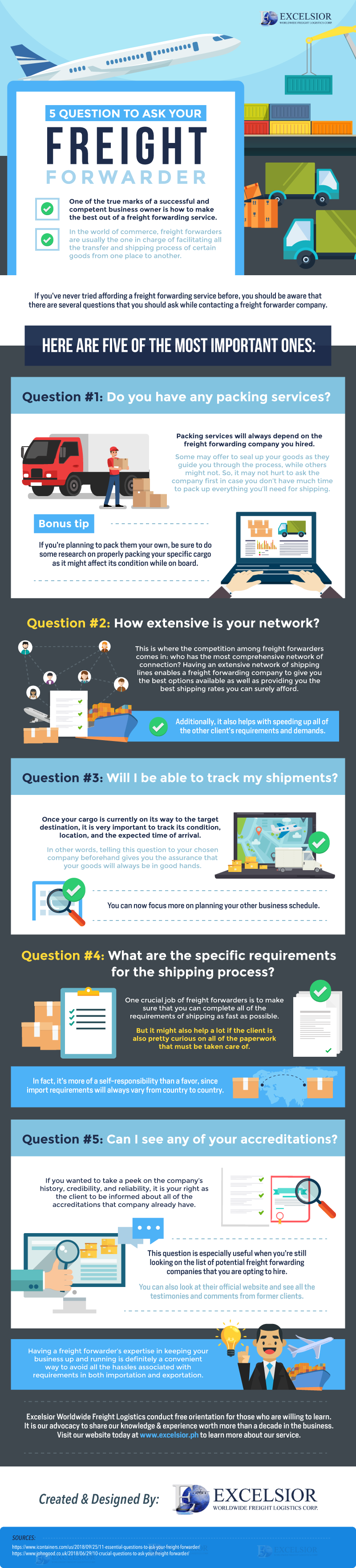
One of the true marks of a successful and competent business owner is how to make the best out of a freight forwarding service. In the world of commerce, freight forwarders are usually the one in charge of facilitating all the transfer and shipping process of certain goods from one place to another.

If you’ve never tried affording a freight forwarding service before, you should be aware that there are several questions that you should ask while contacting a freight forwarder company. Here are five of the most important ones:

5 Questions to Ask your Freight Forwarder - Infographic

Question #1: Do you have any packing services?

Packing services will always depend on the freight forwarding company you hired. Some may offer to seal up your goods as they guide you through the process, while others might not. So, it may not hurt to ask the company first in case you don’t have much time to pack up everything you’ll need for shipping.

Bonus tip: If you’re planning to pack them your own, be sure to do some research on properly packing your specific cargo as it might affect its condition while on board.

Question #2: How extensive is your network?

This is where the competition among freight forwarders comes in: who has the most comprehensive network of connection? Having an extensive network of shipping lines enables a freight forwarding company to give you the best options available as well as providing you the best shipping rates you can surely afford.

Additionally, it also helps with speeding up all of the other client’s requirements and demands.

Question #3: Will I be able to track my shipments?

Once your cargo is currently on its way to the target destination, it is very important to track its condition, location, and the expected time of arrival. In other words, telling this question to your chosen company beforehand gives you the assurance that your goods will always be in good hands.

You can now focus more on planning your other business schedule.

Question #4: What are the specific requirements for the shipping process?

One crucial job of freight forwarders is to make sure that you can complete all of the requirements of shipping as fast as possible. But it might also help a lot if the client is also pretty curious on all of the paperwork that must be taken care of. In fact, it’s more of a self-responsibility than a favor, since import requirements will always vary from country to country.

Question #5: Can I see any of your accreditations?

If you wanted to take a peek on the company’s history, credibility, and reliability, it is your right as the client to be informed about all of the accreditations that company already have. This question is especially useful when you’re still looking on the list of potential freight forwarding companies that you are opting to hire. You can also look at their official website and see all the testimonies and comments from former clients.

Having a freight forwarder’s expertise in keeping your business up and running is definitely a convenient way to avoid all the hassles associated with requirements in both importation and exportation.

Excelsior Worldwide Freight Logistics conduct free orientation for those who are willing to learn. It is our advocacy to share our knowledge & experience worth more than a decade in the business. Visit our website today at www.excelsior.ph to learn more about our service.
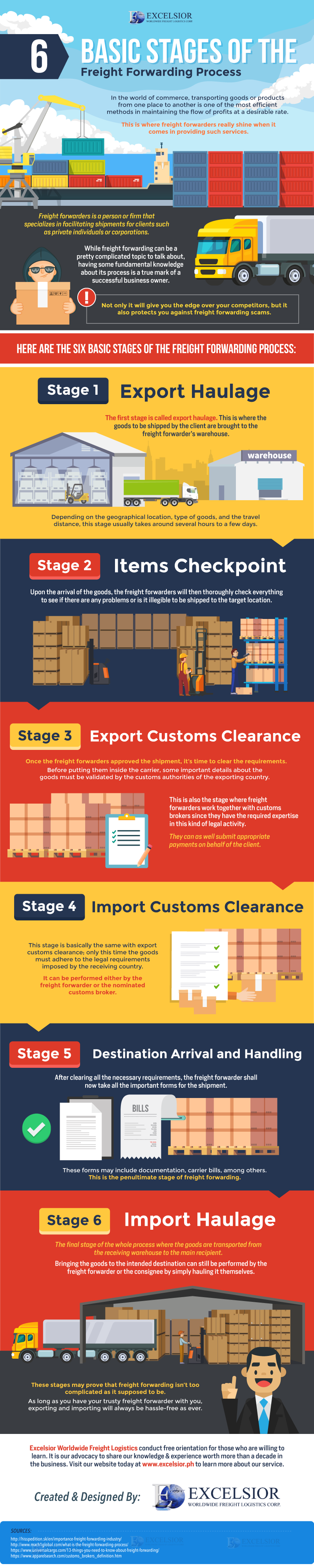
6 Basic Stages of the Freight Forwarding Process – Infographic

In the world of commerce, transporting goods or products from one place to another is one of the most efficient methods in maintaining the flow of profits at a desirable rate. This is where freight forwarders really shine when it comes in providing such services.

Freight forwarders is a person or firm that specializes in facilitating shipments for clients such as private individuals or corporations. While freight forwarding can be a pretty complicated topic to talk about, having some fundamental knowledge about its process is a true mark of a successful business owner. Not only it will give you the edge over your competitors, but it also protects you against freight forwarding scams.

Here are the six basic stages of the freight forwarding process:

6 Basic Stages of the Freight Forwarding Process - Infographic

Stage 1 – Export Haulage

The first stage is called export haulage. This is where the goods to be shipped by the client are brought to the freight forwarder’s warehouse. Depending on the geographical location, type of goods, and the travel distance, this stage usually takes around several hours to a few days.

Stage 2 – Items Checkpoint

Upon the arrival of the goods, the freight forwarders will then thoroughly check everything to see if there are any problems or is it illegible to be shipped to the target location.

Stage 3 – Export Customs Clearance

Once the freight forwarders approved the shipment, it’s time to clear the requirements. Before putting them inside the carrier, some important details about the goods must be validated by the customs authorities of the exporting country.

This is also the stage where freight forwarders work together with customs brokers since they have the required expertise in this kind of legal activity. They can as well submit appropriate payments on behalf of the client.

Stage 4 – Import Customs Clearance

This stage is basically the same with export customs clearance; only this time the goods must adhere to the legal requirements imposed by the receiving country. It can be performed either by the freight forwarder or the nominated customs broker.

Stage 5 – Destination Arrival and Handling

After clearing all the necessary requirements, the freight forwarder shall now take all the important forms for the shipment. These forms may include documentation, carrier bills, among others. This is the penultimate stage of freight forwarding.

Stage 6 – Import Haulage

The final stage of the whole process where the goods are transported from the receiving warehouse to the main recipient. Bringing the goods to the intended destination can still be performed by the freight forwarder or the consignee by simply hauling it themselves.

These stages may prove that freight forwarding isn’t too complicated as it supposed to be. As long as you have your trusty freight forwarder with you, exporting and importing will always be hassle-free as ever.

Excelsior Worldwide Freight Logistics conduct free orientation for those who are willing to learn. It is our advocacy to share our knowledge & experience worth more than a decade in the business. Visit our website today at www.excelsior.ph to learn more about our service.

 

What’s the Difference Between a Freight Forwarder and a Customs Broker – Infographic

Some exporters nowadays often mistook a freight forwarder for a customs broker and vice versa. While may be working in the same industry, both are fairly different from each other. Here are some of the telltale facts that draw the fine line between the two professions.

Difference Between a Freight Forwarder and a Customs Broker - Infographic

1. Definitions

A Freight Forwarder is an agent or company that specializes in logistics and organizing of shipments in place of an individual or a company, to transport their goods. This kind of service usually requires a great deal of connection in the supply chain.

On the other hand, a Customs Broker is a private individual or firm that serves as guide for both importers and exporters in meeting the necessary requirements given by the customs authorities.

2. Duties and Responsibilities

Freight Forwarders are the ones responsible for handling all the processes when it comes in exportation of a cargo. From bringing the goods to its mode of shipment (e.g. truck, plane, or ship) to its arrival at the target destination, the freight forwarders have it all covered.  They also give advice as to how to get the best deal for the cost of transportation, as well as guarantee the safety and timely arrival of the goods. To know more about the importance of a freight forwarder please check out the infographic

here
.

Customs Brokers are in charge of submitting all important documents like clearances in order for the shipments to be legally allowed to enter its country of destination. They also tend to have a wide area of knowledge when it comes in every entry procedure, including other payments like taxes and fees for imported merchandise. In addition to that they can also help shippers through the following:

  • Customs bonds
  • Importer Security Fillings
  • Dispatching for final delivery
  • Duty drawback
  • Reconciliation

One thing custom broker can be similar with freight forwarders is that they can as well give recommendations. Only this time, they do it for the purpose of providing the client on getting the most efficient way of clearing their goods in accordance to customs entry rules and regulations.

3. Can a Freight Forwarder be a Customs Broker at the same time?

Since Freight forwarders can be a wider term compared to customs brokers which has a more specific job, there are cases in which a freight forwarder can offer services similar to that of a customs broker. However, not every customs broker can be a freight forwarder.

For many business owners trying import or export their goods, having both freight forwarders and customs brokers are very critical in ensuring its proper arrival on time while adhering to the complicated rules and process of international shipment.

Excelsior Worldwide Freight Logistics conduct free orientation for those who are willing to learn more about importation and exportation. It is our advocacy to share our knowledge & experience for 17 years in the business. Visit our website today at www.excelsior.ph to learn more about our service.
Excelsior Worldwide Logistics Corp.