Freight Forwarder In The Philippines: 6 Things You Should Look For (Infographic)

Choosing a freight forwarder is a crucial decision for every business because you need someone whom you can rely on and entrust the safety of your goods.

It is no secret that there are freight forwarding companies who get banned, imprisoned and fined for illegal operations.

There are also some who just aren’t knowledgeable with the ins and outs of the industry, leading to mistakes and inefficiency.

Having that said, here are seven things that you should look for in a freight forwarder in the Philippines to make sure that your transaction goes smooth:

Freight Forwarder in the Philippines 6 things you should look for - Infographic

Expertise

When a freight forwarder has been in business for more than a decade, it’s a good indication that they have sufficient knowledge on transport rules and regulations and have already encountered and overcome lots of challenges in the past, given the fact that they outlasted other freight forwarding companies in the competitive industry.

That is why choosing an accomplished freight forwarder over a newbie will give you more assurance that your transaction will be a satisfying one.

A good business reputation

In connection to expertise in the industry, a good business reputation also comes along with it. They wouldn’t last long in the industry if their services aren’t satisfying, and if they aren’t professional when it comes to dealing with customers because negative customer feedbacks are a deal-breaker.

The good thing is aside from word-of-mouth, you can now check their customer reviews online to know whether their customers are satisfied with their service or not.

A vast network  

Another benefit of choosing a freight forwarder who has been in the industry for a long period of time is that they’ve already built connections with multiple logistics companies worldwide, and they can use it negotiate for better prices on your behalf, wherever you’re importing from around the globe.

Accreditation

Aside from long industry experience, you can also evaluate whether a freight forwarder can be trusted or not through checking if they are accredited or not.

Before any transaction, look for a certificate of accreditation from the Department of Trade and Industry first or check the recent list of accredited Non-Vessel Operating Common Carriers (NVOCCs), International Freight Forwarders (IFFs) and Domestic Freight Forwarders (DFFs) at the official website of DTI.

A customs broker’s license

If the freight forwarder also offers customs brokerage services, you should look for a custom’s broker license to ensure that they are really knowledgeable on preparing necessary documents, country-specific rules and regulations, and calculation of duties and related taxes. Otherwise, you might end up wasting money and your shipments held at customs.

Excellent customer care

Good customer service should always be a priority when looking for partners in business, especially when you will entrust them to deliver your goods on time and in good condition.

A freight forwarder with excellent customer care manifests effective communication skills and good business etiquette.

Try to inquire first to determine whether or not they are polite, willing to answer your questions, and attentive to details. If they aren’t, better look for another one that you can get along with, understands your needs and is truly concerned with your business.

Otherwise, your transaction might fail due to miscommunication and misunderstanding. In worse cases, it might even result in lawsuits.

Here at Excelsior Worldwide Freight Logistics, we treat our clients as partners. We also conduct free orientation for those who are willing to learn about importation and exportation. It is our advocacy to share our knowledge and experience for 17 years in the business.

Contact us today (063) 525-9775 or visit our website www.excelsior.ph


Sources:


Chinese New Year: Tips to Keep Your Supply Chain Efficient (Infographic)

If you have been importing from China over the past years, you’re probably already aware that the Chinese New Year is one of the freight peak seasons that you should prepare for.

However, if it’s your first time, here is a detailed discussion of how the Chinese New Year can affect your supply chain:

The Chinese New Year is the most important holiday in China, that is why it is a tradition among Chinese people to take some time off and celebrate it with their family.  

In fact, during its celebration, businesses temporarily shut down because they are focused on cleaning their houses thoroughly (to remove negative energy) and on preparing food for the feast.

As a result, freight demands shoot up, prices increase, and containers easily become full, making it expensive and difficult to import.

Having that said, here are four tips to keep your supply chain efficient during the Chinese New Year:

Chinese New Year- Tips to Keep Your Supply Chain Efficient - Infographic

Confirm your supplier’s schedule

As mentioned earlier, Chinese people are focused on preparing for the new year’s celebration. For that reason, most Chinese suppliers start to wind down their operations one to two weeks in advance.

Aside from an early halt in operations, some Chinese suppliers also take long  in resuming to their normal operations that’s why you need to confirm your supplier’s schedule so that you can place your orders while they’re still performing transactions.

Failing to confirm your supplier’s schedule can have you waiting for a month or two to place an order again since the Chinese New Year celebration usually lasts for sixteen days and that’s a red alert for import delay.

Place your orders in advance

Confirming your supplier’s schedule will enable you to place your order in time but why do it on time when you can do it early?

Placing your orders in advance won’t only help you avoid delays, it will also help you cut back on expenses and find adequate space for your shipments.

Everyone is on a rush months before the Chinese New Year that’s why you need to be proactive. Placing your orders early will help you get ahead of other importers on choosing the most affordable freight rate and obtaining the lowest GRI (General Rate Increase) possible. You will also be able to reserve enough shipping space for your goods before containers run out of space.

Split your shipments

Another technique that you can use to keep your supply chain efficient during the Chinese New Year is splitting your shipments into two categories: Urgent and non-urgent.

Urgent shipments are time-sensitive goods that are either perishable or needed immediately by its user. On the other hand, non-urgent shipments are non-perishable goods that aren’t needed immediately but still needs to be delivered on time.

During the Chinese New Year freight peak season, you should consider transporting only your urgent shipments because non-urgent shipments can be transported during the regular season wherein the demand and rates are low.

Collaborate with a trusted local freight forwarder

Collaborating with a trusted freight forwarder will free you of all the trouble that comes with importing because they got the trust of their clients for a reason.

Most trusted freight forwarders are knowledgeable with freight peak seasons and has connections with multiple international transport organizations. In short, your freight forwarder can help you negotiate with your supplier for better prices.

Moreover, they will take care of the paperwork you need for importing, that’s why you can sit back and relax throughout the process.

Here at Excelsior Worldwide Freight Logistics, you can make sure that you’re in the right hands. We don’t only have equipped and experienced people that are committed to keeping our clients’ supply chain efficient, we also conduct free orientation for those who are willing to learn about importation & exportation because it is our advocacy to share our knowledge & experience for 17 years in the business. 

Visit our website today at www.excelsior.ph or contact us at (063) 525-9775

Sources:

6 Signs that it’s Time for you to Find a New Freight Forwarder and Customs Broker (Infographic)

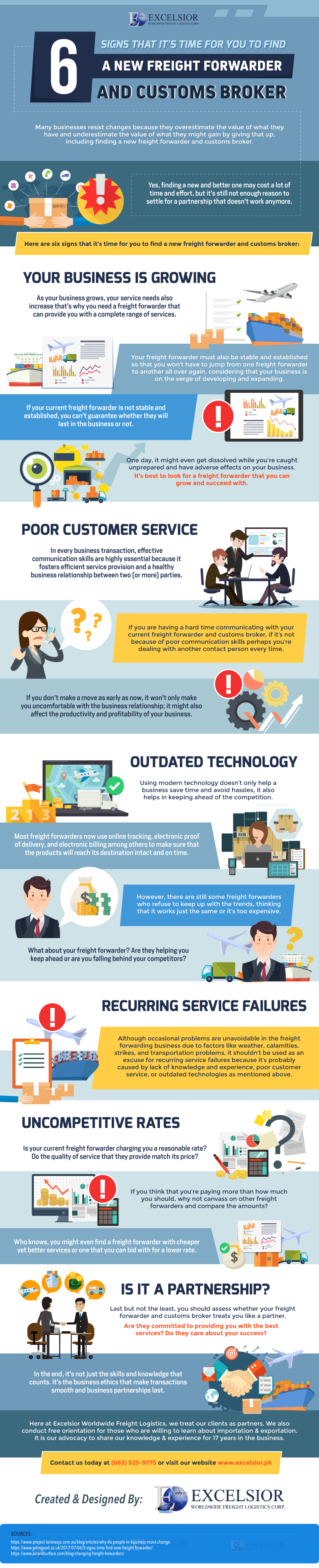
Many businesses resist changes because they overestimate the value of what they have and underestimate the value of what they might gain by giving that up, including finding a new freight forwarder and customs broker. Yes, finding a new and better one may cost a lot of time and effort, but it’s still not enough reason to settle for a partnership that doesn’t work anymore. Here are six signs that it’s time for you to find a new freight forwarder and customs broker:

6 Signs that it’s Time for you to Find a New Freight Forwarder and Customs Broker (Infographic)

Your business is growing

As your business grows, your service needs also increase that’s why you need a freight forwarder that can provide you with a complete range of services.

Your freight forwarder must also be stable and established so that you won’t have to jump from one freight forwarder to another all over again, considering that your business is on the verge of developing and expanding.

If your current freight forwarder is not stable and established, you can’t guarantee whether they will last in the business or not. One day, it might even get dissolved while you’re caught unprepared and have adverse effects on your business. It’s best to look for a freight forwarder that you can grow and succeed with.

Poor customer service

In every business transaction, effective communication skills are highly essential because it fosters efficient service provision and a healthy business relationship between two (or more) parties.

If you are having a hard time communicating with your current freight forwarder and customs broker, if it’s not because of poor communication skills perhaps you’re dealing with another contact person every time.

If you don’t make a move as early as now, it won’t only make you uncomfortable with the business relationship; it might also affect the productivity and profitability of your business.

Outdated technology

Using modern technology doesn’t only help a business save time and avoid hassles, it also helps in keeping ahead of the competition.

Most freight forwarders now use online tracking, electronic proof of delivery, and electronic billing among others to make sure that the products will reach its destination intact and on time.

However, there are still some freight forwarders who refuse to keep up with the trends, thinking that it works just the same or it’s too expensive. What about your freight forwarder? Are they helping you keep ahead or are you falling behind your competitors?

Recurring service failures

Although occasional problems are unavoidable in the freight forwarding business due to factors like weather, calamities, strikes, and transportation problems, it shouldn’t be used as an excuse for recurring service failures because it’s probably caused by lack of knowledge and experience, poor customer service, or outdated technologies as mentioned above.

Uncompetitive rates

Is your current freight forwarder charging you a reasonable rate? Do the quality of service that they provide match its price? If you think that you’re paying more than how much you should, why not canvass on other freight forwarders and compare the amounts? Who knows, you might even find a freight forwarder with cheaper yet better services or one that you can bid with for a lower rate.

Is it a partnership?

Last but not the least, you should assess whether your freight forwarder and customs broker treats you like a partner. Are they committed to providing you with the best services? Do they care about your success?

In the end, it’s not just the skills and knowledge that counts. It’s the business ethics that make transactions smooth and business partnerships last.

Here at Excelsior Worldwide Freight Logistics, we treat our clients as partners. We also conduct free orientation for those who are willing to learn about importation & exportation. It is our advocacy to share our knowledge & experience for 17 years in the business. 

Contact us today at (063) 525-9775 or visit our website www.excelsior.ph


Sources:

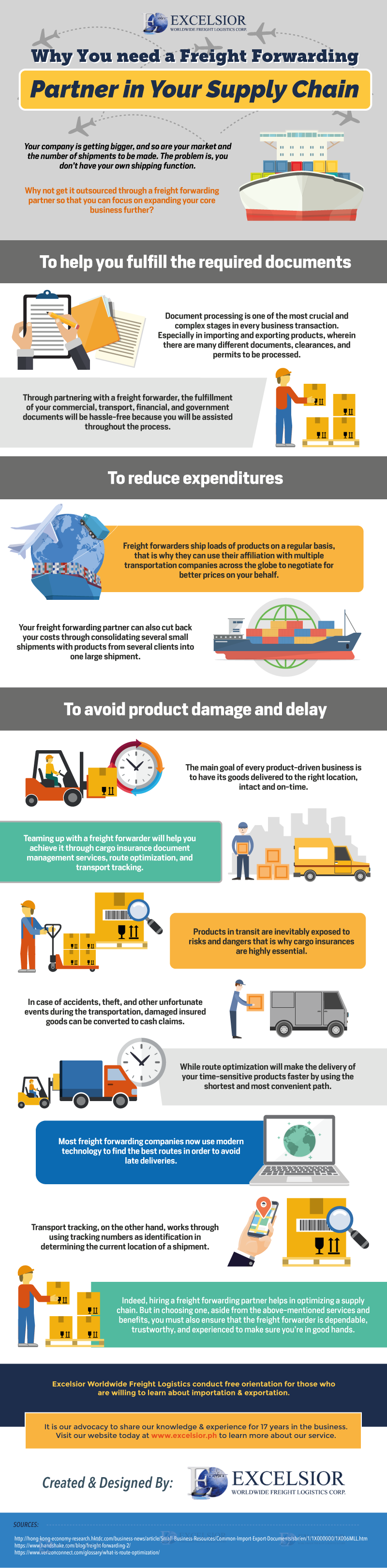
Why You Need a Freight Forwarding Partner in Your Supply Chain (Infographic)

Your company is getting bigger, and so are your market and the number of shipments to be made. The problem is, you don’t have your own shipping function. Why not get it outsourced through a freight forwarding partner so that you can focus on expanding your core business further?

Why You Need a Freight Forwarding Partner in Your Supply Chain

To help you fulfill the required documents

Document processing is one of the most crucial and complex stages in every business transaction. Especially in importing and exporting products, wherein there are many different documents, clearances, and permits to be processed. Through partnering with a freight forwarder, the fulfillment of your commercial, transport, financial, and government documents will be hassle-free because you will be assisted throughout the process.

To reduce expenditures

Freight forwarders ship loads of products on a regular basis, that is why they can use their affiliation with multiple transportation companies across the globe to negotiate for better prices on your behalf. Your freight forwarding partner can also cut back your costs through consolidating several small shipments with products from several clients into one large shipment.

To avoid product damage and delay

The main goal of every product-driven business is to have its goods delivered to the right location, intact and on-time. Teaming up with a freight forwarder will help you achieve it through cargo insurance document management services, route optimization, and transport tracking.

Products in transit are inevitably exposed to risks and dangers that is why cargo insurances are highly essential. In case of accidents, theft, and other unfortunate events during the transportation, damaged insured goods can be converted to cash claims.

While route optimization will make the delivery of your time-sensitive products faster by using the shortest and most convenient path. Most freight forwarding companies now use modern technology to find the best routes in order to avoid late deliveries.

Transport tracking, on the other hand, works through using tracking numbers as identification in determining the current location of a shipment.

Indeed, hiring a freight forwarding partner helps in optimizing a supply chain. But in choosing one, aside from the above-mentioned services and benefits, you must also ensure that the freight forwarder is dependable, trustworthy, and experienced to make sure you’re in good hands.

Excelsior Worldwide freight logistics have been in the business for seventeen years and counting. With trained and experienced employees who uphold the principle of integrity, we provide only the best services to our clients.

Visit our website today at www.excelsior.ph to learn more about our services.

Sources:

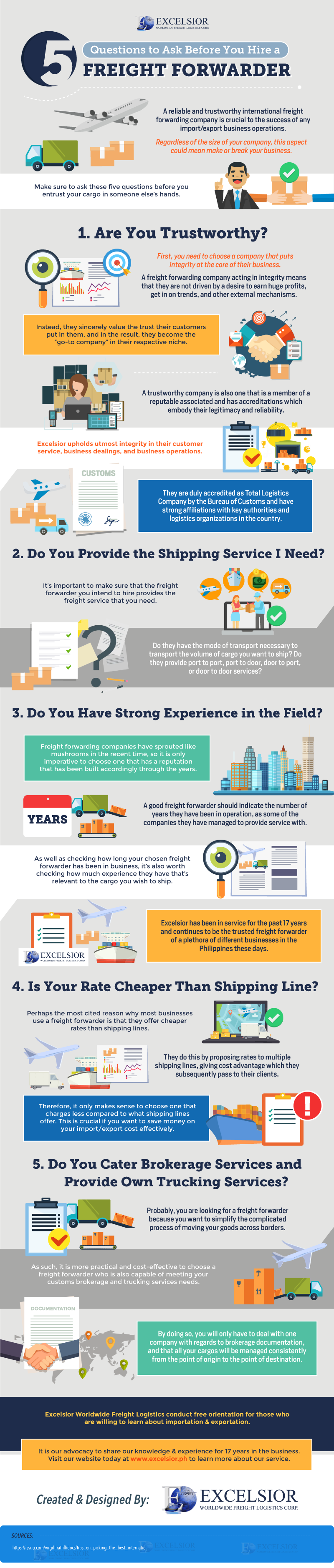
5 Questions to Ask Before You Hire a Freight Forwarder (Infographic)

A reliable and trustworthy international freight forwarding company is crucial to the success of any import/export business operations. Regardless of the size of your company, this aspect could mean make or break your business.

Make sure to ask these five questions before you entrust your cargo in someone else’s hands.

1. Are You Trustworthy?

First, you need to choose a company that puts integrity at the core of their business. A freight forwarding company acting in integrity means that they are not driven by a desire to earn huge profits, get in on trends, and other external mechanisms. Instead, they sincerely value the trust their customers put in them, and in the result, they become the “go-to company” in their respective niche.

A trustworthy company is also one that is a member of a reputable associated and has accreditations which embody their legitimacy and reliability.

Excelsior upholds utmost integrity in their customer service, business dealings, and business operations. They are duly accredited as Total Logistics Company by the Bureau of Customs and have strong affiliations with key authorities and logistics organizations in the country.

2. Do You Provide the Shipping Service I Need?

It’s important to make sure that the freight forwarder you intend to hire provides the freight service that you need. Do they have the mode of transport necessary to transport the volume of cargo you want to ship? Do they provide port to port, port to door, door to port, or door to door services?

3. Do You Have Strong Experience in the Field?

Freight forwarding companies have sprouted like mushrooms in the recent time, so it is only imperative to choose one that has a reputation that has been built accordingly through the years. A good freight forwarder should indicate the number of years they have been in operation, as some of the companies they have managed to provide service with.

As well as checking how long your chosen freight forwarder has been in business, it’s also worth checking how much experience they have that’s relevant to the cargo you wish to ship. Excelsior has been in service for the past 17 years and continues to be the trusted freight forwarder of a plethora of different businesses in the Philippines these days.

4. Is Your Rate Cheaper Than Shipping Line?

Perhaps the most cited reason why most businesses use a freight forwarder is that they offer cheaper rates than shipping lines. They do this by proposing rates to multiple shipping lines, giving cost advantage which they subsequently pass to their clients.  Therefore, it only makes sense to choose one that charges less compared to what shipping lines offer. This is crucial if you want to save money on your import/export cost effectively.

5. Do You Cater Brokerage Services and Provide Own Trucking Services?

Probably, you are looking for a freight forwarder because you want to simplify the complicated process of moving your goods across borders. As such, it is more practical and cost-effective to choose a freight forwarder who is also capable of meeting your customs brokerage and trucking services needs.

By doing so, you will only have to deal with one company with regards to brokerage documentation, and that all your cargos will be managed consistently from the point of origin to the point of destination.

Excelsior Worldwide Freight Logistics conduct free orientation for those who are willing to learn about importation & exportation. It is our advocacy to share our knowledge & experience for 17 years in the business. Visit our website today at www.excelsior.ph to learn more about our service. 


Sources:
https://issuu.com/virgill.ratliff/docs/tips_on_picking_the_best_internatio

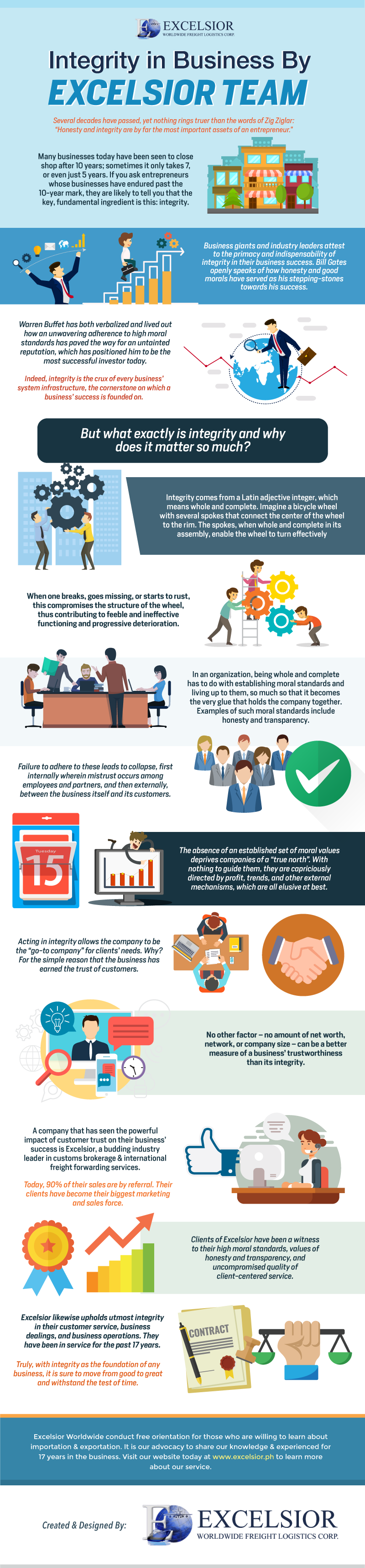
Integrity in Business By Excelsior Team (Infographic)

Several decades have passed, yet nothing rings truer than the words of Zig Ziglar: “Honesty and integrity are by far the most important assets of an entrepreneur.”

Many businesses today have been seen to close shop after 10 years; sometimes it only takes 7, or even just 5 years. If you ask entrepreneurs whose businesses have endured past the 10-year mark, they are likely to tell you that the key, the fundamental ingredient is this: integrity.

Business giants and industry leaders attest to the primacy and indispensability of integrity in their business success. Bill Gates openly speaks of how honesty and good morals have served as his stepping-stones towards his success. Warren Buffet has both verbalized and lived out how an unwavering adherence to high moral standards has paved the way for an untainted reputation, which has positioned him to be the most successful investor today.

Indeed, integrity is the crux of every business’ system infrastructure, the cornerstone on which a business’ success is founded on.

Integrity in Business By Excelsior Team

But what exactly is integrity and why does it matter so much?

Integrity comes from a Latin adjective integer, which means whole and complete. Imagine a bicycle wheel with several spokes that connect the center of the wheel to the rim. The spokes, when whole and complete in its assembly, enable the wheel to turn effectively. When one breaks, goes missing, or starts to rust, this compromises the structure of the wheel, thus contributing to feeble and ineffective functioning and progressive deterioration.

In an organization, being whole and complete has to do with establishing moral standards and living up to them, so much so that it becomes the very glue that holds the company together. Examples of such moral standards include honesty and transparency. Failure to adhere to these leads to collapse, first internally wherein mistrust occurs among employees and partners, and then externally, between the business itself and its customers.

The absence of an established set of moral values deprives companies of a “true north”. With nothing to guide them, they are capriciously directed by profit, trends, and other external mechanisms, which are all elusive at best.

Acting in integrity allows the company to be the “go-to company” for clients’ needs. Why? For the simple reason that the business has earned the trust of customers. No other factor – no amount of net worth, network, or company size – can be a better measure of a business’ trustworthiness than its integrity.

A company that has seen the powerful impact of customer trust on their business’ success is Excelsior, a budding industry leader in customs brokerage & international freight forwarding services. Today, 90% of their sales are by referral. Their clients have become their biggest marketing and sales force.

Clients of Excelsior have been a witness to their high moral standards, values of honesty and transparency, and uncompromised quality of client-centered service. Excelsior likewise upholds utmost integrity in their customer service, business dealings, and business operations. They have been in service for the past 17 years.

Truly, with integrity as the foundation of any business, it is sure to move from good to great and withstand the test of time.

Excelsior Worldwide conduct free orientation for those who are willing to learn about importation & exportation. It is our advocacy to share our knowledge & experienced for 17 years in the business. Visit our website today at www.excelsior.ph to learn more about our service.

Customs Compliance for Philippine Importers: Things to Know About the Tariff System of the CMTA (Infographic)

On 30 May 2016, the Republic Act (RA) No. 10863, otherwise known as the Customs Modernization and Tariff Act was implemented signed, which amended many sections of the Tariff and Customs Code of the Philippines (TCCP).

This Act changed the course of the relationship between Customs and Trade by modernizing Customs rules and procedures for faster trade, reduce opportunities for corruption while improving Customs service delivery and efficiency of the supply chain.

Customs Compliance for Philippine Importers - Things to Know About the Tariff System of the CMTA

What Happened After the CMTA Was Signed?

From the CMTA, several new concepts emerged – all of which aim to facilitate a smoother transaction between businesses and the Customs, adoption of internal best practices, and simplified and harmonized processes, among others. These new concepts include:

  • Expansion of the customs mandate to include trade facilitation
  • Promotion of ‘paperless’ transactions through the use of information and communication technology.
  • Definition of “free zones” to harmonize rule and regulations governing all special economic zones, free ports, and similar authorities.
  • Provision for tax and duty status in on ‘relief consignments’ to, among others, promote donations and international aid during calamities and major disasters.
  • Provision for legal interests in case of non-payment of duties and taxes.
  • Procedure for an advance ruling to allow early resolution of customs issues even if there is no actual importation involved.
  • The provision on ‘Authorized Economic Operator’ or AEO, an expansion of the original concept of ‘Authorized Operator’ under the Revised Kyoto Convention (RKC) and adoption of the expanded program of the World Customs Organization (WCO) to promote both trade compliance and security in the supply chain.
  • Definition of ‘Alerts’ to harmonize and simplify rules of the apprehension of shipments, to make the process transparent for the trading community, and to prevent abuse by customs and enforcement officers.
  • Provision for summary remedies such as distraint on personal property and levy on real property to collect duties, taxes, and other charges arising from a customs audit.
  • Creation of a Forfeiture Fund for outsourcing customs functions, facilitating processes, capacity building, and modernization through automation; and
  • Creation of Congressional Customs and Tariff Oversight Committee to oversee the implementation of the CMTA.

Changes in Tariff System

The Tariff Administration and Policy (Title XVI) of the Act are composed of three chapters, with most of the provisions being based on the old code.

  • Chapter 1 – Tariff Commission

A major change in the old code provides the commission the power and function to issue an advance ruling on the tariff classification of imported goods and render rulings on disputes over tariff classification. This section also restates the jurisdiction of the commission over trade remedy measures – dumping, safeguard, and countervailing duties.

  • Chapter 2 – Flexible Tariffs

This section restates the old provisions on “flexible clause” and “promotion of foreign trade.” The flexible clause empowers the President to:

  • Increase, reduce, or remove existing rates of import duty.
  • Establish import quotas or ban imports of any commodity.
  • Impose additional duty on all imports not exceeding 10% ad valorem.
  • Chapter 3 Tariff Nomenclature and Rate of Duty

This section restates many of the old provisions of the provides the tariff classification and duty system for imported and exported goods. This chapter is composed of 3 sections as follows:

  • General Rules on Interpretation (Section 1610)
  • Tariff Nomenclature and Rates of Import Duty (Section 1611)
  • Tariff Nomenclature and Rates of Export Duty (Section 1612)

Implications of the Revised Tariff System

Under the revised tariff system, certain adjustments (depending on the INCOTERM used) may be made on the invoice price to arrive at the dutiable value. The classification process for regularly imported goods remains simple and straightforward, while the opposite can be expected for finished and processed goods as well as for new products that involve composites or mixtures.

The new product classification system provided is mainly based on the 8-digit ASEAN Harmonized Tariff Nomenclature (AHTN), the first six digits of which is based on the Harmonized System (HS) while the seventh and eighth digit codes are assigned to ASEAN subheadings with more than 10,000 tariff lines. Beyond the 8-digit level, member countries are allowed to create national subheadings.

How can Importers Make Sense of These Regulations?

All importers are encouraged to review this document on an annual basis to support their due diligence in exercising Reasonable Care in all international transactions with Customs.  Importers and their trusted brokers should work through the questions in this publication annually to ensure that both are using the information, tools, and guidance provided by BoC to submit accurate entries every time.

If you have further questions regarding the Tariff System under the CMTA, contact Excelsior Worldwide Freight Logistics Corp. by visiting our website at www.excelsior.ph, or you may reach us by calling (063) 525-9775 or send us an e-mail through wecare@excelsior.ph

Excelsior Worldwide conduct free orientation for those who are willing to learn about importation & exportation. It is our advocacy to share our knowledge & experienced for 17 yrs. in the business.

Why Now is the Best Time to Establish an Import-Export Business in the Philippines? (Infographic)

The import-export sector in the Philippines is on the rise. According to Philippine Statistics Authority (PSA), the country’s total trade grew by 8.6% in December 2017, pushing a full-year trade growth to its current rate. This is better than the 5.8% full-year trade growth recorded in 2016.

Imports and exports posted 10.2 percent and 9.5 percent growth rates, respectively, exceeding the Development Budget Coordinating Committee’s emerging estimates (as of December 2017) of 9.0 percent for imports and 8.0 percent for exports.

Such improvement has made the Philippines one of the fastest growing economies in the world, according to the World Bank’s latest edition of Global Economic Prospects. As the country emerges as a growing economic hub, it is wise to ride the wave and make the most out of it by establishing an import-export business in the Philippines.

Read on as we detail in this infographic the reasons why now is the best time to establish an import-export business in the Philippines.

Why Now is the Best Time to Establish an Import-Export Business in the Philippines
1. Presence of Trade Programs and Affiliations

Plenty of government and non-government organizations promote importing and exporting in the country. These organizations have programs which goal is to help aspiring importers and exporters start their business with a firm foundation as possible.

The Philippine Exporters Confederation, the Bureau of Export Trade Promotion, and the Philippine International Trading Corporation are the most popular of these groups. The Philippine government is ramping up these organizations – hoping to promote the country as a destination for foreign investment and exports.

These groups also help to negotiate trade agreements which also open many opportunities for exporters and importers. Some of the trade agreements that are currently in place are the Philippine-Japan Economic Partnership Agreement (PJEPA), ASEAN-India Comprehensive Economic Cooperation Agreement, ASEAN Free Trade Area, and ASEAN-[Republic of] Korea Comprehensive Economic Cooperation Agreement, among others.

2. Relaxing Foreign Ownership Limitations

Foreign ownership restrictions have been a significant issue in the Philippine international trading sector for many years. However, President Rodrigo Duterte is planning to ease these foreign ownership limits in Philippines businesses.

In 2017, the President has directed the National Economic Development Authority to take “immediate steps” to lift restrictions on foreign investments. The NEDA’s efforts to ease restrictions include labor recruitment, public services, rice and corn production, milling, processing, and trading – among others.

The opening of the Philippine economy reveals previously unreachable markets. Whether you are looking to set up an import-export business there, or simply find a supplier, the future is bright.

3. Monetary and Tax Incentives

The Philippines boasts 326 economic zones across the country – which are composed of export processing zones, free trade zones, and industrial estates. Establishing a trading company in economic zones can benefit you from duty-free imports, with some exemptions from particular taxes and other import restrictions as well.

The Asia Development Bank (ABD) also offers to finance to businesses looking to invest in the Philippines. Businesses can also avoid local taxes, duties on event materials, and travel fees – all depending on the situation.

4. Increased Support for Private Businesses

One of the biggest development in the Philippines international trade scene is the privatization. President Rodrigo Duterte plans to move many Government Owned and Controlled Corporations (GOCCs) into the private sector which would allow local businesses and investors to participate to previously untapped industries such as healthcare, energy, transportation, etc.

While there are domestic concerns for this shift, allowing more private businesses to participate in government projects may increase innovation and is expected to create more investment opportunities for international companies.

To be successful in the Philippines, or any international region, import-export businesses need a reliable and trustworthy logistics partner. A reliable and honest freight forwarding company provide significant advantages that will not only help you gain a competitive edge but also ensures that all your import and export transactions are done legally, ethically, on budget and on time.

If you need a helping hand on starting your import and export business today, Contact Excelsior Worldwide Freight Logistics Corp. and let us help you in your journey in the import-export industry this 2018 and beyond. Call us at (+632) 525-9775 or email us at wecare@excelsior.ph.

Excelsior Worldwide Logistics Corp.